
Intentional Productivity: 9 Tips to achieving success in life
What does productivity mean to you?
For some, it’s all about managing time and achieving success.
I used to see productivity as an endless cycle of work, with little room for rest or balance. At one point I treated myself like a human machine. I was always “on” and in a “go… go.. go..” mode.
Perhaps you share this perspective, where productivity is synonymous with work and business. And yes, there is truth in that.
But what if I told you that productivity can be so much more?
And that it can go beyond getting stuff done.
It can become a mindset, a deliberate action that will help you achieve success in life.
All you need to do is infuse intentionality in what you do.
Your simple ‘to-do’ items injected with intention, become intentional actions
If you’re seeking a way to approach productivity with less overwhelm and more purpose, keep reading.
You’ll learn how to get things done in a more chill and intentional way and I’ll also give you valuable tips on how to implement the ideas.
With a clear intention guiding your actions, you’ll learn how to be productive not just for the sake of “busyness”.
DISCLOSURE: This post contains affiliate links which means I receive commissions at no additional cost to you if you click through and make a purchase using those links. See my full Disclaimer here.

What is intentional productivity anyway?
We’ve all been there.
You sit down to complete a task only to get sidetracked.
You set out to do one thing but you end up working on a lot of things that aren’t entirely related to what you’re meant to do in the first place.
Then, you stress out at the end of the day, because the tasks didn’t get done. It gets worse when you feel guilty about making the wrong choice.
I get it.
I have since embraced intentional living for several years now and honestly, I do have this experience from time to time.
And if this resonates with you, I think it’ll benefit you to try intentional productivity.
But what is intentional productivity?
The simple answer:
Intentional productivity means being purposeful about how you use your time and energy.
It’s about focusing on what truly matters to you, setting clear goals, and taking deliberate actions to achieve them while maintaining balance and well-being.
The meatier answer:
Intentional Productivity is chilled and intentional way of doing things.
It’s not just about streamlining and simplifying your to-do list but experiencing life’s ebbs and flows with purpose and grace.
When you practise intentional productivity, you deliberately immerse yourself in a deep work at a specific time, far away from distractions.
You trade shallow, multitask-oriented behaviours for intense, uninterrupted periods of focus. Where you let your creativity and productivity flourish. And by doing so, you draw yourself closer to you aspirations, personal and professional goals.
It’s more than managing what you do with your time (time management), it’s a lifestyle choice, a part of intentional living that lets you experience a fulfilled and meaningful life.
In essence: intentional productivity is doing the right things at the right time for the right reason.
9 Tips on how to practise Intentional Productivity
Here are some tips I’ve gathered over time that will empower you to embrace intentional productivity. By implementing these strategies, you’ll be able to make the most of your time and energy based on what works best for you.
As you practise intentional productivity on a daily basis, you’ll also notice some mindset shifts such as being conscious about the use of your resources – your time, energy and space.
You’ll discover that to achieve your goals, you do not need to drive yourself to the ground working like a slave. Instead, you have the power to approach tasks with intentionality, allowing you to be productive without succumbing to stress.
With intentionality in every action you take, you’ll find yourself making conscious choices about where and when to invest your valuable resources. Just like managing money wisely, managing your time and energy becomes an intentional act, helping you do things in less time which allows you to have more free time.
Consider this collection of tips as your holistic guide in living a purposeful life that also gives you space for getting things done.
1. Set Clear Goals
In other words, know your why.
What’s your why in doing what you do? This question isn’t only for a deep and long self- reflection. It’s applicable to anything really, but let’s stick with the topic of productivity.
The moment you turn on your laptop, what’s your intention?
When you sit down and face your work desk, what’s your goal?
What do you want to achieve, the moment you start working on the first task of your day?
I heard about the importance of knowing the “why” behind taking an action from different people and different books I’ve read, but it’s only through Dr Fran Whitaker I truly appreciate the importance of knowing my why in everything I do.
Why do I choose to sleep instead of doing one more task?
instead of making a “to-do” list, why do I have “done list” instead?
Implementation idea: When you’re about to do something, big or small action, pause for a few seconds and ask yourself: “why do I want to this? What’s my goal?
During the start of your ‘working hours”, set a clear goal. What outcome would you like to achieve?
You can practise the habit of setting clear goals by planning your week, and making it a part of your weekly routine.

2. Determine your Priorities
Know what truly matters.
It’s important to understand what holds real significance in your life because only you have the power to determine that.
Only YOU know what truly MATTERS.
Is it your health? Your family? Your wealth or career? Perhaps it’s your passion and creativity.
Only you can decide what deserves a place on your priority list.
The easy way to know what truly matters is to examine your core values. Your set of core values is your beacon of guide and inspiration to live your life on your terms.
Knowing your priorities is knowing where your focus needs to be in the present moment.

The best way to do this is by practising the habit of being conscious as often as you can. Be aware of what’s going on in the here and now.
What is happening today?
Which task is urgent and important?
Remember that some tasks seems urgent but they might not be important.
What’s essential in the present moment?
When you know what it is, then that’s the first thing you need to pay your attention to and everything else can wait.
Implementation Idea: Try and slow down a bit and examine if your actions are still aligned with your goals? Part of intentional productivity is setting clear boundaries. Draw the line where it makes sense.
Know when you need to stop and take a break.
3. Know where your time goes
If you want to Practise Money Mindfulness, you need to start with knowing your numbers first. You need to be aware of your expenses , is it too high or just right? To achieve financial goals, where can you cut back on? What adjustements can you make?
This way of establishing awareness is the same when it comes to intentional productivity. The only difference is we’re talking about TIME and ENERGY instead of money.
Awareness is the first step because it helps you determine what to focus on and what needs your attention the most.
Without knowing where and how you spend your time currently, how will you know if you’re being truly intentionally productive.
And the first step to awareness is knowing where your time goes.
How do you use your time. What activities or tasks requires a lot of energy from you and are taking the most of your hours, your days and your week?
So if you haven’t already, I encourage you to try and track your time. And you don’t have to do it forever. You can track your time for a 3-day period or maybe 7 days if you want a clearer view of how you spend your time in a week.
And the best part? By tracking your time, it will be easier for you to find a space for self-care. Self-care is something that’s easily forgotten. So make sure you include it in your list.
I wish I learned the value of self-care earlier than I did. I admit, I only learned how to practise self-care when I started this blog. So if you haven’t made a conscious effort yet to prioritise self-care, please start today.
You’ll be amazed at how much better life is when you take actions to nourish yourself.
Self-care is paying attention and taking action (big and small) to nurture your body, soul and spirit.
Whether its a well-earned holiday or a short hour to have time for yourself, make sure you create space to spend time with yourself.
Read a book, do gardening, write on your journal, go to a spa, have a massage or just stay in and do whatever fills your cup. There are so many ways you can prioritise yourself and you don’t need to spend heaps of money if you don’t want to.
All you need is a time for yourself.
Always remember. You only have one body. There’s only one of you. Everything is meaningless and productivity is pointless if you’re unwell.
As you go deeper into living an intentional life, you’ll learn more and more about prioritising yourself.
Implementation Idea: Do a time-audit. Track your time for a small period of time. You can do 3-days or a week if you like. When doing your time-audit, take note not only what you’re doing at a specific moment, but also include your energy levels.
After doing your time audit you’ll know where you can make adjustments to make sure that what you do is aligned with what you’re trying to achieve.
4. Write things down

Got new ideas?
Write them down.
Thinking of a big project?
Write it down.
This is one of the best thing I learned from David Allen, the author of Getting Things Done Method.
Try to write things down as they come. It can be done on your phone or by pen and paper.
I’m an analog person even now that I’m blogging. But because blogging can’t be done on analog alone so I have embraced using both analog and digital. I use Bullet Journal and Notion which are so perfect for each other.
When tackling a to-do list, I’m analog all the way. Ahhh that feeling the moment you cross that item on the list.
I love my Bullet Journal so I’m biased with the use of good old pen and paper. But this doesn’t mean you have to do what I do.
You can certainly be all digital about writing. It’s perfectly fine. What’s important is you’re keeping a habit of writing things down.
Writing things down helps you with being committed to your purpose.
There’s a power in writing.
When you write things down, you save your precious energy and you take the most of your precious time. You don’t have to think about the same thing over and over trying to remember it.
Implementation Idea: From today, have a pen and paper handy so when things, ideas, important thoughts (that you want to remember) pop in your head, you can write them down.
If you prefer digital, then a simple note taking app on your phone will be a perfect choice. And when you feel overwhelmed with circling thoughts in your head, it’s a good idea to do a brain dump.
5. Prioritise your tasks
If you’re a mum like me, then you must be a master multitasker too.
But……
If you want to embrace intentional productivity, you need to also move away from too much multitasking.
You need to master prioritising instead.
Of course there are exceptions. While doing household chores, it make sense to do other things. For example if you’re folding clothes, doing laundry or cooking, then it’s ok to do something else like listening to audiobooks, podcast or music.
However, if you’re doing more important work, it’s best to do one thing at time.
Here’s a great way to prioritise your tasks. And you can do it in 3 easy steps.
- Create a mother list of all the things you want to do, big and small. This will give you a clear overview of everything that needs your attention.
- Assess importance and urgency. Consider each task’s significance and urgency as well the consequences if a task isn’t done at the right time.
- Align with long term goals and values. Prioritise the tasks that align with your big goals and contributes to your personal and professional growth.
Implementation idea: Try the 3 steps above. After doing step 3. Pick the top 3 tasks and start completing them one task at a time. When you finish the first set of 3 tasks, pick another set of tasks. This set of 3 tasks can become your priority lists. Rinse and repeat.
6. Practise Time Blocking
Time blocking is a time management strategy where you set specific block or chunk of time dedicated for doing either a task or set of tasks. This allows you to stay focus and manage distractions.
Here’s how I do time blocking in my Bullet Journal.
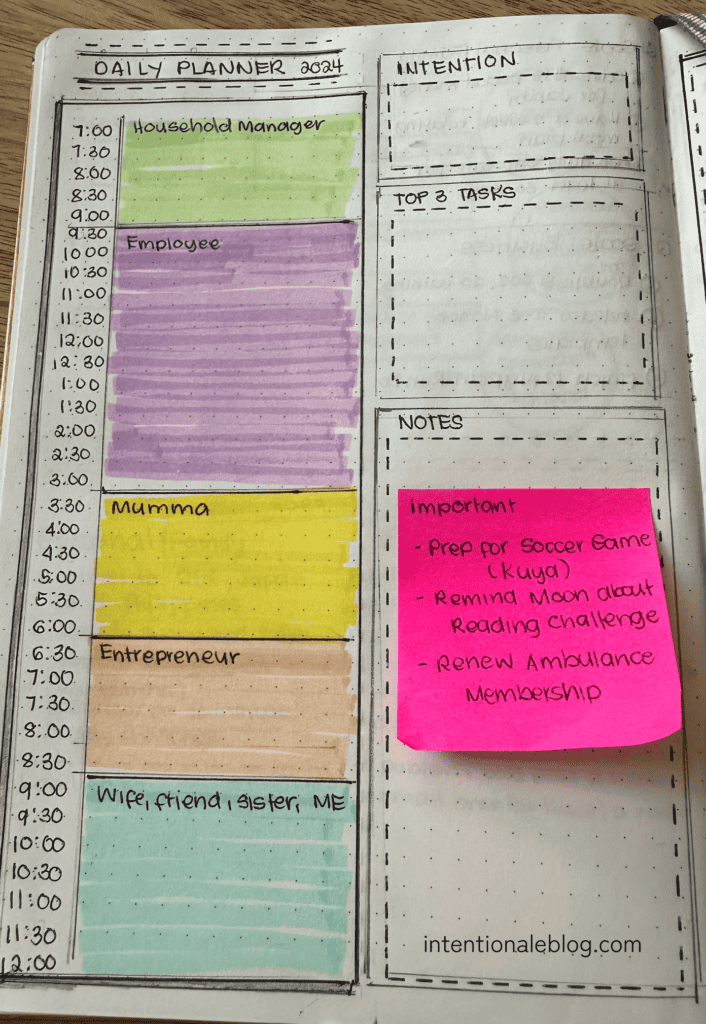
By dedicating specific time blocks to different activities, you create structure.
This intentional approach allows you to immerse yourself fully in each task, giving it the attention it deserves.
In a sense it can be considered one of the mindfulness practices, because this approach encourages you to be present.
Whether it’s working on your blog or business, tackling household chores, or spending quality time with loved ones, time blocking ensures that each task or activity receives the attention it needs.
By consciously allocating time for both work and leisure/play, you keep the balance between productivity and self-care.
This deliberate approach not only increases your efficiency but also allows you to savour the present moment without feeling guilty about unfinished tasks. And believe me, there will always be unfinished tasks. And that’s ok.
Just make sure that when you do your time blocking, you’re also making room for flexibility and establish healthy boundaries. You absolutely do not need to take into account every minute of your day.
Aim to have some blank spaces. let your schedule welcome empty space. And while it’s good to be on top of things, it’s ok if sometimes you’re behind. There’s always next time to do better.
Implementation idea: Grab your calendar or planner and start mapping out your day in dedicated blocks. Experiment with different durations and adjust as needed to find what works best for you. With time blocking, you’ll discover a newfound sense of focus, productivity, and fulfillment. Embrace this practice, and watch as it change your life one block at a time.
7. Create and maintain momentum
Momentum is a physics term that refers to the quantity of motion that an object has. It’s a “mass in motion”. But let’s set aside the “science” definition of this term.
In the productivity space, having momentum is simply doing something continuously or consistently.
So to keep or maintain your momentum towards your goals, you need to keep going.
Do something every day that will help you get closer to your goals.
And of course, if for whatever reason you skip a day or two then it’s ok. You can always reset.
Want to get things done with intention?
Read more about Productivity Affirmations.
Implementation Idea: The biggest challenge when it comes to completing a project or achieving a goal is maintaining momentum.
The smart way of dealing with this challenge is using Trackers. Trackers create and maintain momentum, promotes self-accountability and boost motivation.
So, if you’re not using trackers yet, try using one. Since we’re on the topic of productivity, try Progress Tracker. You can make it as pretty as you like but you can also do it with just text. I keep a progress log in Notion just like this one.
8 Stay Focused
Staying focused means you have your full attention on something. You’re fully engaged with what you’re doing at the present moment.
It also means that you’re in control with the interruptions and the distractions around you.
“ .. interrupt is to disturb or halt an ongoing process or action by interfering suddenly while distract is to divert the attention of”. A distraction, like a noisy environment, is unintentional while an interruption like stopping to do something else is on purpose. – Source
Interruptions and distractions are parts of life and we can’t remove them altogether but they can be managed for sure.
There’s one quote that I found years ago that has been my inspiration on how to use pockets of time. They are indeed like little gems in productivity.
“Guard well your spare moments. They are like uncut diamonds. Discard them and their value will never be known. Improve them and they will become the brightest gems in a useful life.”Ralph Waldo Emerson
Whether it’s 2 minutes or 20 minutes, spare moments need to be treated with intention.
Don’t let those pockets of time slip away and go to waste. Make it your mission to use your time wisely. You can use it to rest, think, do small things and any activity that’s meaningful to you.
9. Be Organised
Being organised is either exciting or boring to some people. Whether you’re in camp A (exciting) or camp B (boring), I hope you’ll hear me out for a second.
Being organised saves you time, energy and money in so many ways.
You don’t have to be crazy organised but just be organised according to your standard.
Decide what’s organised for you. You set the bar, you set the standard.
If it’s good enough for you. Then it’s good enough.
Your next steps
The reason why I’m sharing these tips is for you to consider practising intentional productivity.
Something got you interested in this blog post.
It might be the words “intentional productivity’ or the words “live life on your terms”. Whatever it was, I hope by now you’re fully convinced that intentional productivity is one of the best ways to live your life on your terms.
It’s your ticket to achieving what you want with intention and enjoying the journey as you go.
So go ahead and pick the first implementation idea.
I don’t expect you to make a massive and dramatic change in your productivity. Rather, it would be nice if you try one or two of the tips and see how much difference it makes in your productivity.


