
7 intentional tips on how to have a productive day
Has this happened to you before?
You get to the end of your day. Tired but there’s no satisfaction.
If yes, then it’s time to shift from being reactive to being proactive, so you can end your days feeling accomplished and fulfilled.
And don’t worry you’re not alone.
I’ve been there too.
A lot of times.
But through intentional living, and embracing intentional weekly planning, I’ve learned how to avoid those days.
Full disclosure: I still have that kind of day every now and then but it’s definitely way less than before.
So, if you can relate, keep reading you’re going to learn about the 7 intentional tips on how to have a more productive day.
If you haven’t already, I created a Free Printable Sunshine Weekly Planner and a Free Weekly Planner in Notion. Both were thoughtfully created to help you create a productive and intentional week.

DISCLOSURE: As an Amazon Associate, I earn from qualifying purchases. This post contains affiliate links which means I receive a commission at no additional cost to you if you click through and make a purchase using those links. See my full Disclaimer here.
The unproductive day
But first, let’s talk about how an unproductive day looks and feels like.
This resonates with me because I used to have many unproductive days. Often, it was because I was reactive rather than proactive. Whenever something popped into my head or demanded my attention, I felt compelled to stop and address it immediately.
And frankly, it still happens from time to time, but I know better now.
An unproductive day looks like you’ve done a lot in the entire day. And yes, you did a lot, as it shows in your to-do list.
However…
It feels like something is missing.
You’ve checked off tasks, responded to emails, attended meetings, and maybe even managed a few errands. But at the end of your workday, there’s still this nagging feeling that you haven’t accomplished anything meaningful. It’s like you’ve been busy, but your day wasn’t the most productive.
And then it hits all of a sudden.
You’ve just been going through the motions and doing things for the sake of doing them.
Your busy schedule has overtaken you.
All the things you’ve done that day were done because they seemed urgent, but in reality, they weren’t.
You’ve been reactive instead of proactive.

How a productive day looks like
A productive day is not a perfect day- (though, it could be sometimes, but not all the time).
I wanted to highlight that, because I don’t want you to aim for a productive day by trying to make your day perfect.
Remember that you can have a productive day even if the day isn’t perfect. So let’s define what an ideal productive day is.
This is my version, on a personal level, but feel free to have your own version.
My day is productive when:
- at least 1 important work is done at the end of each day
- my daily tasks are organised from the most important tasks to the least priority tasks
- I have short breaks in between focus times and I’ve given enough time for me to reset for the following day
- my daily schedule is flexible enough for me to take on something unexpected without increasing stress levels
- no matter how tight my work schedule is, I still find free time to do something for myself or my family.
- even if I don’t have much time, I’m still able to move my projects forward
- my daily to-do list doesn’t own me and control me
And for me, a productive day always start with a good weekly plan. Find out how you can create a weekly planning routine for productivity.

How to Have a Productive Day
Here are the following tips on how to have an intentional and productive day. These are easy tips to implement but I encourage you to only take one to two tips at a time.
Don’t feel like you have to do them all at the same time. That’s a recipe for not following through.
- Practise Intentional Planning
- Establish Routines such as Morning Routine, Evening Routine or Weekly Planning Routine.
- Set Daily Intention
- Prioritise Tasks
- Manage distractions
- Take Regular Breaks
- Schedule regular reflection. Reflect daily or do a Weekly Review.
1. Practise Intentional Planning
Intentional Planning is a way of shaping your path in a way that your actions are aligned with what you’re trying to achieve.
It’s a mindful process of setting clear goals, which are based on your personal values and beliefs.
After reading this post, I invite you to read Intentional Planning: Use the Power of a Planner, where I share the simplified cycle of intentional planning. I think it’ll help you too if you want to embrace intentional daily productivity.

A big part of intentional planning is making the most of your time and finding balance among your priorities through effective time management. In my version of intentional living, I aim to maintain a healthy (not perfect) balance within the 3 most important areas of my life. Time, Money and Productivity. Learn more about it from the Trifecta of Living your best life.
Here’s a list of a few more blog posts that will help you with intentional planning.
- 12-Week Year Planning Guide – to help your goals faster
- Find out how to be intentional using the Free Intentional Weekly Planner.
- 7 Steps Weekly Planning Process to a Productive Week.
- Quarterly Planning Process in 7 easy steps
- Setting Monthly Goals with 33 Monthly Goals Example
- Weekly Goals Ideas to live an intentional life

2. Establish Routines
A routine is a set sequence of regularly followed actions, in a consistent order, designed to create structure, establish good habits, and manage time efficiently.
For example, a daily routine is a regular sequence of actions, or activities performed in a consistent order, and at the same specific time each day to establish structure and efficiency.
Having routines helps you do things in less time and find extra time for fun and creativity. Routines reduce decision fatigue by making certain actions automatic. By focusing more energy on the most important and urgent task, you also decrease mental fatigue. This is done by doing an important particular task instead of taking a few unimportant tasks.
Through routines, you can break big tasks into smaller chunks allowing you to complete them without feeling drained.
So, create a weekly plan.
Here’s how to create a Weekly Planning Routine. And to make the most out of your weekly planning routine, I encourage you to do a weekly review. Here’s How to Make Things Happen through GTD Weekly Review.
And if you need help with setting a Weekly Plan here is the 7 steps Weekly Planning Process.

As you create your weekly planning routine, remember to include different routines. Create different routines such as daily routine, morning and evening routine.
Have a morning routine so you can go through the rest of the day with ease. A good morning routine starts with a healthy breakfast.
Then establish an evening routine to have enough sleep that will help you boost your productivity levels the following day. Successful people swear that having a good night’s sleep as a great way of being more effective and efficient.
3. Set Daily Intention
This doesn’t have to be complicated and you can do this in different ways.
You can write your daily intentions in your day planner or you can just think about it, first thing in the morning.
When I wake up in the morning, I do 2-minute silence. I practise gratitude for a brand new day and set the intention for the day. It’s only 2 minutes but it’s enough time for me to be grateful and set intention for the day.
And then when I get to my day planner after breakfast or after dropping the kids to school, I include my daily intention in my Bullet Journal Daily Log.
4. Prioritise Tasks
Different people have different takes on things.
There is no one-size-fits-all approach to different things when it comes to prioritisation.
So, for clarity, let’s chat about what’s important and what’s urgent, bearing in mind that when something is important it doesn’t mean it’s urgent.
Here’s how I prioritise tasks in Notion. I pick my top 3 most important to do and focus on them first before doing something else.
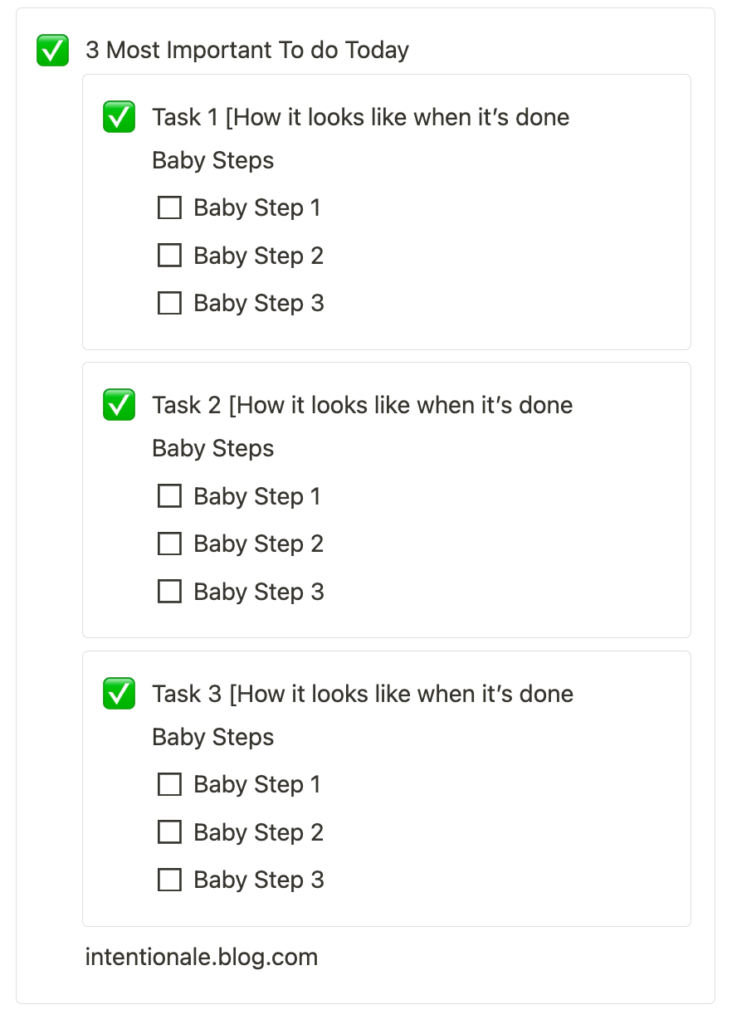
Importance and urgency are the 2 elements that will make it easier for you to prioritise tasks.
Important Tasks
Here’s the list of what I consider Important Tasks. I’m a blogger so they are related to blogging but you get the idea.
- to-do items that are related to my long-term goals. These are tasks I need to do to move a project. An example is writing blog posts related to Money Mindfulness, Intentional Productivity and Intentional Lifestyle to establish authority and attract a loyal audience over time.
- tasks that improve my strategy and the success of my projects. An example is analysing website analytics to identify popular topics and planning content around them to increase engagement and traffic.
- activities that are aligned with my core values. These are activities such as frequent reflection and weekly reviews to make sure I do the right things at the right time.
- things to do that while they may have deadlines, their importance is more about the outcome than timing. An example is creating digital products or online courses that provide value to my audience, focusing on delivering high-quality content even if it takes longer than initially planned. This is to make sure that I provide satisfaction and long-term success for my audience.
Urgent Tasks
And here is the list of what I consider Urgent tasks:
- time-sensitive tasks – Sending out newsletters before a certain promotion ends.
- crisis management tasks – resolving website outages or tech glitches.
- external pressure-related tasks – receiving urgent emails from a subscriber expecting immediate answers to a query.
- interruptions – Unexpected action or an appointment that arises during scheduled blogging time. Urgent family needs.
5. Manage Disruptions and Distractions
When it comes to intentional productivity, one of the main obstacles is the inability to manage disruptions and distractions.
I genuinely believe that if you want to be intentionally productive, you need to aim to manage them instead of totally eliminating them.
Eliminating disruptions and distractions isn’t doable but managing them is.
But what is a disruption and what’s a distraction?
Disruption
Unexpected or external events that forcefully interrupt your workflow. The typical impact is severe and can halt productivity until resolved
Examples:
- sudden phone calls or meetings
- tech issues or internet outages
- emergency situations requiring immediate attention
Distraction
Anything that diverts your attention away from the tasks at hand. The impact is generally self-controllable but can significantly reduce focus if not managed
Examples:
- checking social media
- engaging in irrelevant conversation or doing small tasks not related to what you’re currently doing
- bad habits such as mindless scrolling on the phone.
To manage disruptions you can do a couple things:
- Have a backup plan so when it happens you let go of the rest of your day without feeling bad
- Set boundaries
To manage distractions, here are some ideas
- Turn off notifications and only keep extremely important alerts
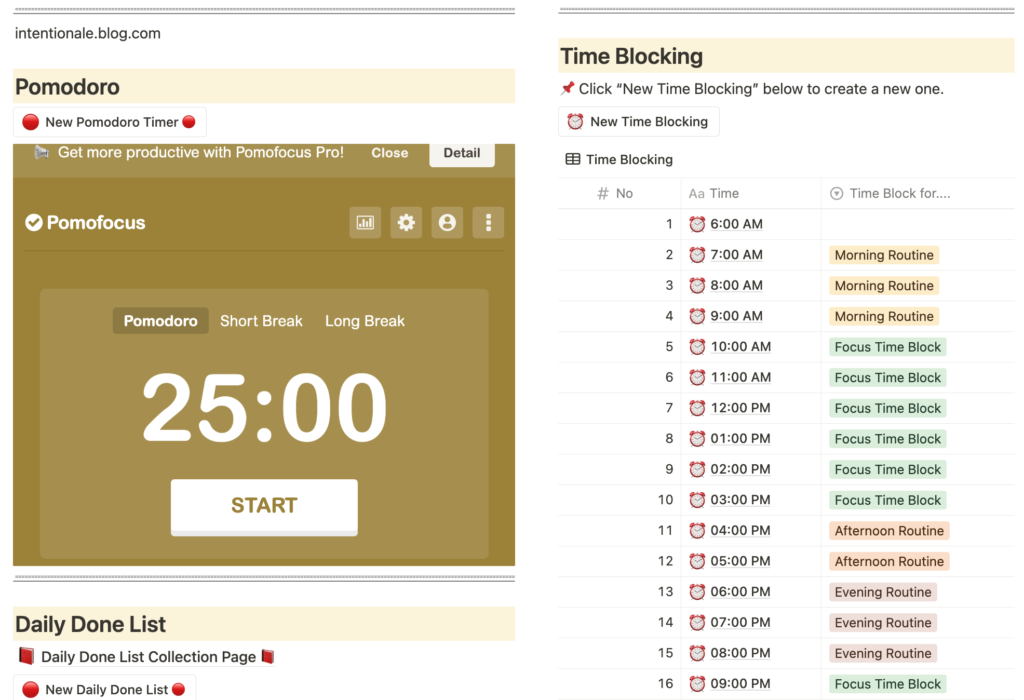
- Schedule focus time. A good way to be truly focused is to use the pomodoro technique
- Take regular breaks
6. Take regular breaks
I’m going to be honest. And it will make me sound hypocritical because I am not really good at taking regular breaks. Sometimes I can work for several hours without taking breaks. Even when I use the Pomodoro technique, sometimes I just ignore that timer for taking a break. But I’ve been trying to do better. In the last couple of months, I joined a coworking space so I just follow the focus time and the break time there. And when it’s break time, I walk away from my work desk and do something else. But the most effective way is asking one of my kids to remind me. She is 8 years old and loves the task. During breaks, we eat snacks together, chat about what happened on the day and sometimes get some fresh air for a few minutes.
7. Schedule Regular Reflection
You can have a plan. And you can execute that plan to the best of your ability. But without reflection, the result might be hit-and-miss. Because without reflection, it would be hard to know if something is working.
Without reflection, how would you know what needs adjustment? How are you going to know if something is working or not?
And when I say reflection I don’t mean spending hours and hours thinking about things. No. Reflection can take from just a few minutes to maybe half an hour to one hour.
You can do daily reflection – which is essentially taking a few minutes of your day to reflect. Kind of checking in with yourself if you’re fulfilling your daily intention.
What I highly recommend is a regular weekly review. Here’s how to make things happen using GTD weekly review

Create an ideal productive day
After knowing the 7 intentional tips on how to have a productive day, I want to leave you with an important question.
What’s your ideal productive day?
Go on, spend a few minutes thinking about how you would like an ideal productive day looks and feel like. Then use the 7 tips (not all at once) to have a your productive days.
And if you don’t have a planner yet, you can download a Free Printable Sunshine Weekly Planner here or the Free Weekly Planner in Notion through this link.


