
3 Biggest Reasons to do a Brain Dump
Endless swirling thoughts.
Mile-long things to do.
Exciting ideas…..
It’s good to have them in your mind but it can be too much sometimes if you keep them for too long in there.
But here’s what you can do.
Do a brain dump.
Brain dump won’t magically turn those nagging thoughts into thin air, but it will help you manage them. It’ll clear your mind, improve your well-bing and even increase your productivity.
After reading this post, you’ll know how to brain dump so you can end mental clutter, keep a clear mind and make more space for creative thinking.
Why do a brain dump?
Think about this for a second.
“A typical healthy human brain contains about 200 billion nerve cells, or neurons, linked to one another via hundreds of trillions of tiny contacts called synapses”, according to Stanford Medicine.
Amazing isn’t it?
It’s hard to fathom how much information it holds and how it process all that information.
No wonder it can be overwhelming when you have too many thoughts to deal with. They can even cause stress to a certain level.
I know this very well because I used to feel stressed by this exact thing.
Just a quick disclaimer. I’m not a medical professional so please do not take this post as professional advice. Reach out to a Medical Professional if you need serious help because you’re too important not to get the help you deserve.
DISCLOSURE: Some of the links in this post are Affiliate Links which means I earn a commission, at no extra cost to you if you use these links to purchase. Please see my Full Disclaimer Here.
What’s a brain dump?
Merriam Webster defines a brain dump as the act or an instance of comprehensively and uncritically expressing and recording one’s thoughts and ideas (as on a particular topic).
“If you don’t pay appropriate attention to what has your attention, it will take more of your attention that it deserves.” David Allen
It’s is a process of externalising your thoughts and ideas where you capture everything that has your attention.
Think about those to-dos, events, tasks, errands, and everything that’s on your mind. When you do a brain dump, you take them all out of your head.
David Allen’s book, Getting Things Done, uses a term ‘mind sweep’. It’s not exactly a brain dump but it’s a form of doing a brain dump.
It’s also a process of externalising ideas and thoughts by capturing them as they come.
Similarly, Ryder Carrol also has a “mental inventory” in his book The Bullet Journal Method which also works similar to a brain dump and mind sweep.
I’ve used both and I’m going to give you examples later in this post.
3 biggest reasons to do a brain dump
There are so many benefits you get when you do a brain dump but here are the 3 biggest reasons.
- You get mental clarity
- It helps you stay focused
- Boost your productivity.
Reason 1: Brain dump clears the mind
Brain dump helps manage our thoughts, instead of leaving them swimming in our heads that causes overwhelm and mental clutter.
Doing a brain dump helps you manage your thoughts by making them more tangible instead of leaving them swimming in your head which causes overwhelm and mental clutter.
“Mind like Water: A mental and and emotional state in which your head is clear, able to create and respond freely, unencumbered with distractions and split focus”. David Allen
Getting Things Done (GTD) book put emphasis on how important it is to have a clear mind.
Having a clear mind helps you focus more on what’s important.
I haven’t reached the point where I’m completely zen but most of the time, my mind is clear, especially after doing a brain dump.
If you’re hyper-motivated person like me then you know how it usually goes.
New ideas keeps you excited. Learning new things seems to temp you all the time. And because there are so many things going on at one time, you feel scattered.
When it feels too much, you get into this mode where you think about a million things at once from time to time. It’s good but it feels crazy right?
It still happens to me occasionally but I know better now. When I catch myself drowning in thoughts I do a brain dump.
Tip: If you feel scattered and need a reset. Reach out for a pen and paper and do a brain dump. No pen and paper handy? No problem. You can use your phone.
Reason 2: Brain dump helps you focus
You can do anything but not everything – David Allen
Have you noticed that it’s so much harder to focus when you’ve got a lot in your mind?
A clear mind helps us focus. And when we’re focused, deciding what’s important is easier. We think objectively and we make better decisions.
Not everything is a priority.
I learned this from using highlighters, back when I used to have scattered thoughts. I used to highlight almost everything on my list. Then I realised, having them almost highlighted makes them all the same.
And to make things worse, because of that mindset, I used to operate like a “human-machine”. If you’re like me, you’d be familiar with skipping meals, sleeping less, basically having zero self-care in the name of hard work.
I’m so glad I got out of that mindset.
It was a dangerous place to be because that was a perfect recipe for overwhelm.
Doing a brain dump slowly helped me get rid of that mindset. I became more strategic in how I do things. I planned better.
That said, I still have those momentary overwhelming situations.
Life is meant to happen. And losing focus is a part of it.
So I always go back to doing a brain dump. More to this when we get to “how often you need to do a brain dump”
Doing a brain dump brings my world right back again and things go in the right place.
At this point, I would know what I need to do first. I know what I should prioritize and what I would need to let go of. ( temporarily or permanently)
Tip: When you’re losing focus. Do a brain dump. It can help you regroup and look at things with fresh eyes.
Reason 3: Brain dump increases productivity
If we want to succeed in achieving our goals it’s a good point to remember that productivity plays a big part in the process.
Before I became intentional, I used to think that when I’m busy, I’m productive. As it turned out it wasn’t true.
You see, I could be busy doing a lot of unimportant things instead of doing a few important ones. Then I would end up feeling drained but have nothing to show for it at the end of the day.
When we do a brain dump, it gives us a chance to recalibrate and reflect on what’s urgent and what can wait. This is often hard to see when things are just in our heads.
Doing a brain dump regularly helps us accomplish more because we can focus on our priorities.
We can be truly productive if we have clarity and focus.
Productivity is important in achieving our goals. Being productive means we are effective and efficient in doing what we’re meant to do to achieve a goal. And we can do this by knowing where to focus our energy and time at any given time.
This doesn’t mean we’re meant to be a working machines.
But it could mean…
Some days we do more, some days we do less and some days we do nothing. And this is perfectly ok.
Tip: Do brain dump to be clear on what’s important to you. Pick a few that you need to prioritize and do them first. The rest can wait.
How to do a brain dump

Here’s the step by step guide on how to do a brain dump (beginner style). Please read the additional notes so the process will make more sense.
Note: If this is your first time doing this, I suggest starting with a 20 minute block of time, have a mini rest of 3 to five minutes and repeat until your head is empty.
A few important notes in doing a brain dump
Tip : When you’re going through your list, pick the most important 1 to 3 items. Deal with them first. Plan, schedule, complete them. Delete if it becomes irrelevant. Then take more from the list as you finish those first batch of priorities. Rinse and repeat.
How often do you need to do a brain dump?
The short answer is: It’s up to you. But I suggest doing it regularly is a good practice because its like refreshing your brain often.
I do a yearly brain dump when R and I do our Yearly Review and Goal Setting.
Then I also do quarterly, monthly and weekly, just to make sure nothing important falls through the cracks.
I also do it randomly. When my tasks are piling up and I feel I am dropping the ball, I do brain dump as soon as I recognise it.
What’s next after doing a brain dump?
After a brain dump session, do remember that you don’t have to do them all. Now that you’ve written down everything, you don’t have to think of things over and over again. You can always just go back to the list. That’s where Planning and Strategizing comes in. (and that’s for another post another time)
Once you picked your top priorities. You need to clarify what are those items. Is your item a task, a project, a reference or is it something you can let go. I talked more about clarification in this post.
A Task requires one action step to complete, a Project requires more than one action steps to complete and a Reference is something you don’t need now but you may need to refer to later. Examples are: receipts and important notes. Reference items need to be filed or place somewhere where you can find them easily when you need them. Items to let go are items that becomes irrelevant or doesn’t spark joy anymore.
Tip: you can also try it this way. When you come back from your list, go through all the items in one go. Clarify each item and batch them. So, you can group all the tasks, projects and references. Then pick your top priorities. Plan and schedule when you’ll complete them.
2-minute rule after a brain dump
Over time, I have created a little routine for myself in doing a brain dump.
I do a 2-minute rule right after brain dump. What I do is go through the list and pick the items that I can do in 2 minutes or less. You’d be surprised how many tasks you can complete.
If there are too many “2-minute tasks.”, I group them and batch work on them. Batch work is doing similar tasks together in one go.
Other practices similar to a brain dump
Mind sweep and Mental Inventory are the 2 other practices that are similar to doing a brain dump.
I do a mind sweep on the go. So when an idea pops up in my head I jot it down. I have a note on my phone I call “Capture”. This is where I put everything and then I go through it every week during the weekly review.
I have been using the Bullet Journal Method for a while before I discovered the Getting Things Done method and over time mind sweep and mental inventory kind of intertwined now with brain dump in my whole system.
I do mindset on the go, I do brain dump during review and I do mental inventory when I feel like I have to be more reflective and it’s like a form of mindfulness.
In the first few years of using the Bullet Journal Method, I did a lot of the Mental Inventory and it helped me so much in gaining more clarity and overcoming overwhelm.
Mental inventory from the Bullet Journal Method

I like how Ryder Carroll compares mental inventory to cleaning the pantry. I can relate a lot with it. It makes so much sense. He said, when we are cleaning the pantry, we need to take everything out. It is the beginning of the process.
When doing Mental Inventory, we externalise our thoughts by using a pen and paper. “Make a list of all the things we are working on, what we should be working on and want to be working on.”
Mind Sweep from Getting Things Done

When, I discovered Getting Things Done method, I learned how to do a Mind Sweep.
The way I do it has evolved over time but it’s something I always recommend to friends as doing a mind sweep can instantly give that “lighter” feeling.
After transferring our thoughts onto paper, it means we don’t have to think of those thoughts over and over again.
My Mental Inventory : {an example}
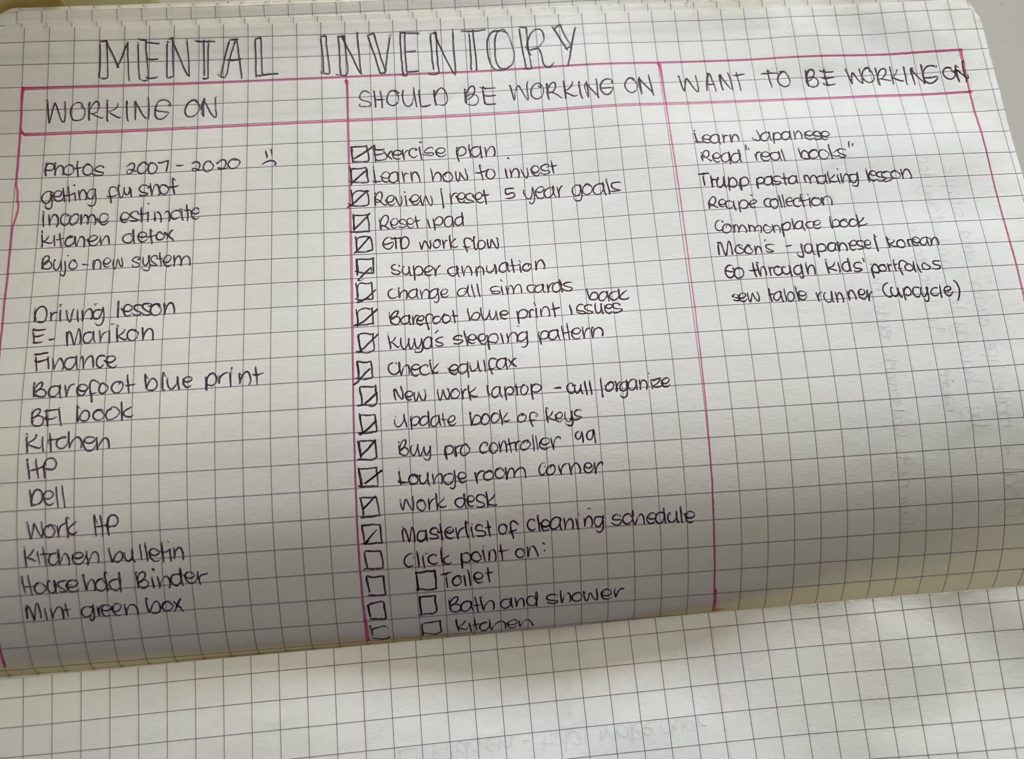
Above is the photo of my mental inventory I did a few years ago.
Even though a Mental inventory is also a form of externalizing one’s thoughts, it’s format is a little bit different from Mind sweep and Brain dump. Mental inventory, helps you think a little bit harder as you write because you need to categorise the thoughts.
I like to think of mental inventory as an organised brain dump while the mind sweep and brain dump are free flowing. Mental inventory is more of a “reflection” side of things. Brain dump and mind sweep are “emptying” your brain.
My 2021 Brain Dump: {an example}

The image above is a brain dump I did at the beginning of 2021. Have I completed them all? No. Will I complete them all? Maybe not. I’ve never completed an entire list in a year ever to be honest. But the point is, a brain dump gives me freedom not to think of those think anymore until such time that I’m ready to complete them.
I like going back to this list as often as possible, so I can assess which ones are still meaningful and which ones don’t spark joy anymore.
Conclusion
Now that you know the 3 biggest reasons why you need to do a brain dump. It’s time to put this idea into practice. I have created a Free download that you can use in your brain dump session.


Awww Christine. This makes me so happy. Yes, brain dump exercise is so helpful. I do it every time I feel overwhelmed by too much things to do. Thanks for sharing your thoughts. Much appreciated