
How to 10x your Productivity: 17 Strategies
Struggling with Productivity?
You’re not alone.
It’s one of those human challenges that can take a lot out of you.
Burnout, lack of focus and work-life balance are a few common issues that arise when you’re struggling with productivity.
It’s stressful…
And overwhelming…
Sometimes it can even cause serious challenges, like lack of sleep and anxiety, that can result in poor decision-making and procrastination.
But don’t worry…
I’ve got 17 Simple Strategies that will help you deal with productivity struggles.
They can even 10x your productivity.
You’ll be able to do it through intentional productivity.
DISCLOSURE: This post contains Affiliate links which means I earn commissions at no cost to you, if you use these links to make purchases. See Full Disclaimer here
What is intentional productivity?

If you’ve been here for a while, then you know that I’m an advocate of Intentional Productivity.
Just like anything else, productivity can be different to different people, by definition and by execution.
And in my version of an intentional living lifestyle, I refer to productivity as “Intentional Productivity”.
I like that because, to me, productivity should be approached with intention or purpose.
It means you don’t only do things just for the sake of doing them.
But you also do them to enjoy the process and appreciate the challenges that come along as you do them.
Have you heard of toxic productivity?
Toxic productivity refers to the harmful mindset or approach to work that prioritises constant busyness, overwork, and achievement at the expense of well-being.
It’s definitely not sustainable.
A sign of toxic productivity is being obsessed with productivity metrics, such as the quantity of completed tasks or number of hours worked, rather than the quality and impact of the work.
Intentional productivity is the opposite of that.
When you’re intentionally productive, you do things at the right time for the right reasons. You find reasonable compromises, so that you can complete a task or finish a project without sacrificing your well-being.
You do things with ease and flow, and you find harmony in all the things that you do, so they don’t become competing priorities.
19 Strategies on how to 10x your Intentional Productivity
I know, I know, 19 is such a big list.
And the last thing I want to happen is to overwhelm you by giving you so many choices.
So…
I picked the Top 8 Strategies to get you started.
- Practise intentional planning
- Consider a Weekly Planning Process that works for you
- Leverage the 12 Week Year Framework
- Pick the right Productivity Method
- Choose the right Productivity Tools
- Only focus on what really matters
- Be organised
- Practise Intentional Planning
1. Intentional Planning

If you want to get to where you want to be with less stress and intention, consider intentional planning.
Intentional Planning isn’t a linear activity, where you start with step one and then stop at the last step. It’s a process that’s ever-evolving as you grow. It’s a cyclical activity and a continuous process of setting, executing and refining your plans.
The productive individuals I know are all planners. They plan, execute and review.
Intentional Planning helps you appreciate the experience while working on your goals instead of being fixated only on your goals.
2. Use the Right Planner

Depending on your style, your planning can be short or long, complex or simple. Your planner can be analog, digital or a combination of both.
I’d love to encourage you to use a planner of your choice and have a planning process in place.
Of course, if you already have this sorted, you can skip to the other strategies.
But if you’re new to planning, I suggest deciding on what type of planner you want to use. Don’t take too much time thinking about what type of planner, just pick one. You can always change later.
I’ve always been an analog person, so Bullet Journal is my first choice. And then I discovered Notion so now I’m using both.
Here’s the 7 Steps Weekly Planning Process that will help you create a productive and intentional week.
You’ll boost your productivity, reduce stress, achieve work-life balance, get the important thing done in less time, and focus on your important work, while still enjoying your personal life with fun and creativity.
2. Leverage the 12-Week Year Framework

In previous years, I used to plan yearly, then break the plan into months, and then execute weekly.
It evolved to planning quarterly, monthly and weekly. I got rid of the yearly planning altogether and set yearly intention instead.
I was happy with this for a while until Nov 2023, when a dear friend and life coach Dr Fran Whitaker. introduced the 12 Week Year Framework. It’s from a book 12 Week Year by Brian P. Moran and Michael Lennington.
And I loved it since then.
I love it so much that I wrote 12 Week Year Planning Guide to Achieve your Goals Faster.
3. Pick the right Productivity Method
Did you know that productivity can be so much more than just working and checking off items on your to-do list?
Seriously, it can go beyond getting stuff done.
You can develop it into a mindset, a deliberate action that’ll help you achieve your goals
You simply need to infuse intentionality into what you do.
If you’re seeking a way to approach productivity with less overwhelm and more purpose, here are the 9 tips to achieving success in life through Intentional Productivity.
There are a lot of productivity methods you can choose from and you don’t need to pick just one.
I personally use a combination of the Getting Things Done, KanBan Method and Bullet Journal Method.
Here are some productivity methods.
- Getting Things Done
- Bullet Journal Method
- Using Kanban Boards
- Eisenhower Matrix:
- Pomodoro Techniques
- 1-3-5 Rule
- Time Blocking
- Pareto Principle
- ABC Method
- Rice Method
- MoSCoW Method
Picking the right Productivity Method will help you improve your Time Management Skills and Prioritisation.
Keep testing different methods until you find the ones that click and keep using them.
The right method is the one that works for you and gives you the best results.
4. Choose the right Productivity Tools
Once you’re happy with your choice of Productivity Method, you also need to consider the Productivity Tools you would like to use. Having the right tools will help you make the most of your valuable time.
You’ll be more efficient and intentionally productive.
In my intentional Arsenal, my top 3 tools are:
- Bullet Journal
- Notion
- Sunsama
I’ve been using Bullet Journal since 2015 and Notion since 2019. I discovered Sunsama in April 2024, so I can’t really tell you yet how long I’ll keep it.
One thing more, like writing blog posts about what works for me, so I published about Notion Weekly Planner.
5. Only focus on what really matters

One of my favourite books is Greg McKeown’s book “Essentialism: The Disciplined Pursuit of Less.
It’s one of those books that I keep coming back to when I need to remind myself to keep steady when things are starting to feel too much.
If you want to be truly productive, start with embracing the power of choice. You have the power to choose how you spend your time and energy.
Determine what’s essential and eliminate what’s not. This will help you focus on what truly matters.
Be present.
Try to be as present as much as you can, because being present helps you determine what’s important in the here and now.
When you’re doing your most important work, you only need to prioritise one thing.
The bitter truth is: if you have many priorities at a given moment, then you don’t really have one.
What’s important in the here and now is not necessarily the most important for tomorrow, or next week or next month.
For me, at the present season of my life, there are only 3 that matter and that’s what I’m focusing on.
Money Mindfulness, Intentional Productivity, and Purposeful Lifestyle; these 3 areas are the core focus of my chosen lifestyle now.
Anything that’s not related to these is considered unessential.
It’s a good idea to think about all the areas of your life and then pick a few areas that you want to focus on.
6. Be Organised

Being organised is one of the simplest strategies I know for productivity. Please take note, I said simple, not easy.
It’s good for saving time, for reducing stress and for prioritisation.
Being organised doesn’t only apply to physical. It also applies to digital and mental aspects of your daily life.
When it comes to being organised, there are 3 books I like to recommend.
- Getting Things Done Method – David Allen
- The Life-Changing Magic of Tidying Up – Marie Kondo
- Building a Second Brain by Tiago Forte
Getting things done method taught me how to manage my tasks and projects. Using a weekly planner such as the Notion Weekly Planner is a great way to stay organised.
I learned how to practise “joy check” from Marie Kondo. It just means if something or (even a person) isn’t sparking joy, I let go. When it comes to organising and managing information, I go by the Building a Second Brain Principle.
7. Embrace Intentional Living

Depending on how you look at it, living with intention may or may not be obviously related to productivity, but I promise you they are very much related.
Intentional living helps you improve your productivity because it promotes being clear, focused and purposeful with what you do.
And it ripples from there.
You learn how to prioritise high-impact activities and manage distractions.
By aligning your personal values with your goals, you also learn to incorporate mindful planning and self-care.
This leads to a balanced, efficient, and sustainable approach to achieving your meaningful goals.
If you’re keen to embrace intentional living, here are 9 Ways to Live on Purpose.
8. Prioritise Self-care
In the space of Intentional Productivity, the one true priority and one that deserves to be number one is Self-care.
It’s often overlooked yet, it’s the one thing that fuels productivity, and has the most impact in it.
I’m guilty of this, and I’m trying to get better one week at a time.
Mu suggestion is to pick one aspect of self-care and the improve.
I always go for the simplest.
So I focus on sleep, nutrition and exercise.
9. Practise Mindfulness

Practising mindfulness can boost your productivity tenfold.
By focusing on the present, you cut out the noise and stress.
You stay on task and manage any disruption and distractions.
Some of the mindfulness exercises are deep breathing, short meditation, and walking to clear the mind.
I find it hard to stay still so my favourite mindfulness activities are: walking, practising 2-minute silence during short breaks, and Bullet Journaling. I love doing daily log and Friday Weekly Review.
Speaking of Weekly Review, here’s How to Make Things Happen with the GTD Method Weekly Review.
10. Live one week at a time

I love, love, love this idea for so many reasons.
I’ve been practising this for more than 8 years now.
Try it and you might like it too. It’ll help you focus on what’s right in front of you, and not worry too much about the future.
It’ll also help you stay grounded and you’ll enjoy life a little bit more.
The best part of living one week at a time in terms of productivity is its power to let you experience life in a 7-day time frame.
One week which is not too short not too long.
It’s a 7-day period where you can practise mindful scheduling, execution and review.
It allows you to be flexible.
If you’re focusing on different areas of your life, such as health, money, and family, for example, you can even alternate your focus each week.
Here are 118 Weekly Goals and Ideas to live an Intentional Life.
You’ll find goals for inspiration or take them as is, and you can even flip the ideas in the Productivity Category to create your own productivity strategies (or productivity hacks).
Need a little help with weekly planning?
Here’s my recommended process.
11. Take one day at a time

When I say live one week at a time, I mean treating one week as if it’s a year, quarter, or a month, just a very small version of them. You plan, strategise, execute and reflect. Then rinse and repeat every week.
However, I want to highlight the power of having a productive day because this is where your weekly success depends. That said, it’s so important to take one day at a time because not all days are going to be productive.
So, celebrate your productive days and give yourself some grace during days when they’re not as productive as you hoped.
12. Review frequently
Regular review or reflection is one element of any productivity method that deserves a special space and time in your schedule. When you hear of review or reflection, it’s a common notion that one needs to stop, pause and slow down.
And that’s the true essence of this practice. It’s meant to encourage taking a pause and slow down a little bit.
And you’ve got to.
I honestly have to bribe myself sometimes to do this except for my Friday Weekly Review.
Yes, it seems counterproductive.
But, to be fast, you’ve got to slow down.
13. Aim for the Imperfect Balance
You may have heard people say this a lot. “Find balance”. Or “Create balance”.
It used to be me, and when I say balance, in my head it’s a perfect equilibrium.
Oh boy, I was so wrong.
No wonder I never achieved it.
It’s because there’s no such thing. A perfect balance doesn’t exist in life.
Something has to give.
One big realisation I had since embracing an intentional lifestyle is letting go of balance.
There’s no perfect balance, only reasonable or healthy compromise. I can’t be a great ideal mum, wife, friend, employee and blogger, all at the same time.
So I’m happy to be an ok employee and be “my” ideal kind of mother in some weeks and vice versa.
14. Be Accountable
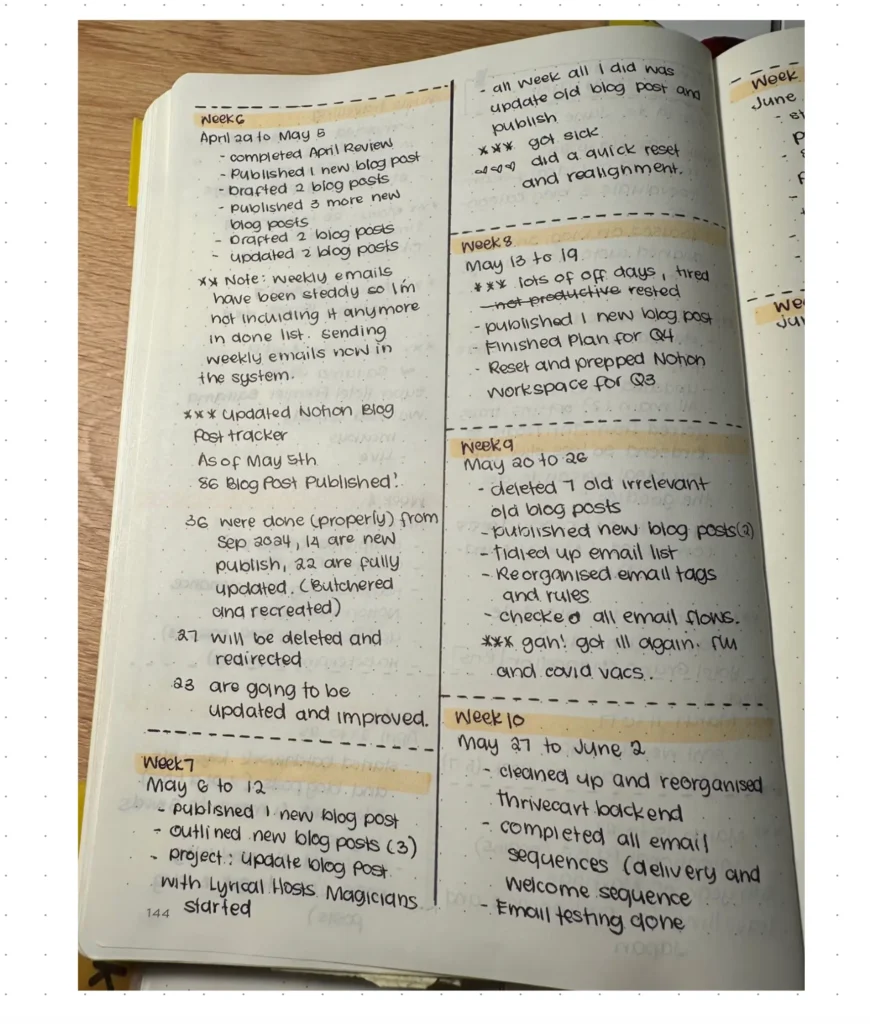
Accountability is one of the core elements of Intentional Productivity.
By holding yourself accountable, you’ll be more focused on ownership of your actions and results instead of excuses.
Accountability pushes improvement, encourages learning from setbacks and stays on course.
Do you wanna know the epitome of an accountable person?
It’s someone who consistently takes responsibility for his or her actions, decisions and commitments.
Someone who demonstrates integrity and takes proactive steps to rectify mistakes and learn from them.
In one sentence. You’re accountable when you do what you said you would do.
15. Be Consistent
Being consistent goes hand in hand with accountability because consistency ensures that actions, behaviours, and commitments are upheld over time.
When you’re accountable, you take ownership of your responsibilities and commitments. Which naturally leads to a pattern of consistent behaviour.
This consistency builds trust in yourself and it boosts your confident too, because it’s clear proof that you are well capable of anything you put your mind to.
Moreover, maintaining consistency reinforces the habit of accountability, making it easier to stay on track and achieve long-term success.
To be consistent, focus on small and consistent action.
And this isn’t only related to intentional productivity.
It can be applied to personal growth, work and relationships as well.
17. Build Good Habits

To be intentionally productive, you also need to build good habits and let go of unhelpful habits.
Build good habits to create a stable foundation for consistent and focused effort towards your goals. These habits also streamline your daily routines, and reduce decision fatigue, as you maximise your time and energy, while maintaining alignment with your core values.
Here’s a great way to build good habits:
- start with small and manageable actions
- be consistent (use a tracker, it’s going to help a lot)
- reinforce consistency by documenting your progress
- create a supportive environment
Habits formation takes time and dedication so be patient and persistent.
Your next actions
That is a big list of strategies.
And you’ve guessed it!
I always say take one or two, implement them, reflect and review.
Keep them if they work for you, if not, let go and try the next.
If you don’t have these planners yet, you can download them here.


