
12-Week Year Planning Guide to achieve your goals faster
Frustrated with chasing goals that always seem just out of reach?
I have something for you.
Let me share with you a 12-week year planning method that will redefine your goal-setting and execution.
It’ll help you embrace a new way of living where every day counts.
It’s a fresh approach to shifting your focus from annualized thinking to 12-week execution periods. You’ll have momentum and clarity that’ll help you make more consistent and measurable progress.
Aside from that, you’ll also learn how to condense your effort and focus, into shorter and more intense bursts of productivity.
That way, you’ll not only reach your goals (personal or professional goals) but do so faster than you’ve ever thought possible.
You’ll have momentum and clarity, so you’ll never be confused about what the next step would be.
Before you continue:
A disclosure in the name of transparency and freebies because I appreciate you.
DISCLOSURE:This post contains Affiliate Links which means I earn commissions at no cost to you, if you use those links to make purchases. Read my Full Disclaimer here.

The 12-week year mindset shift
Keeping a productivity mindset intentionally is the key to doing well.
Thinking “there’s just not enough time” is a common thought of a lot of people. (including myself).
But that’s not really true.
We all get the same 24 hours each day—it’s just about how we use them.
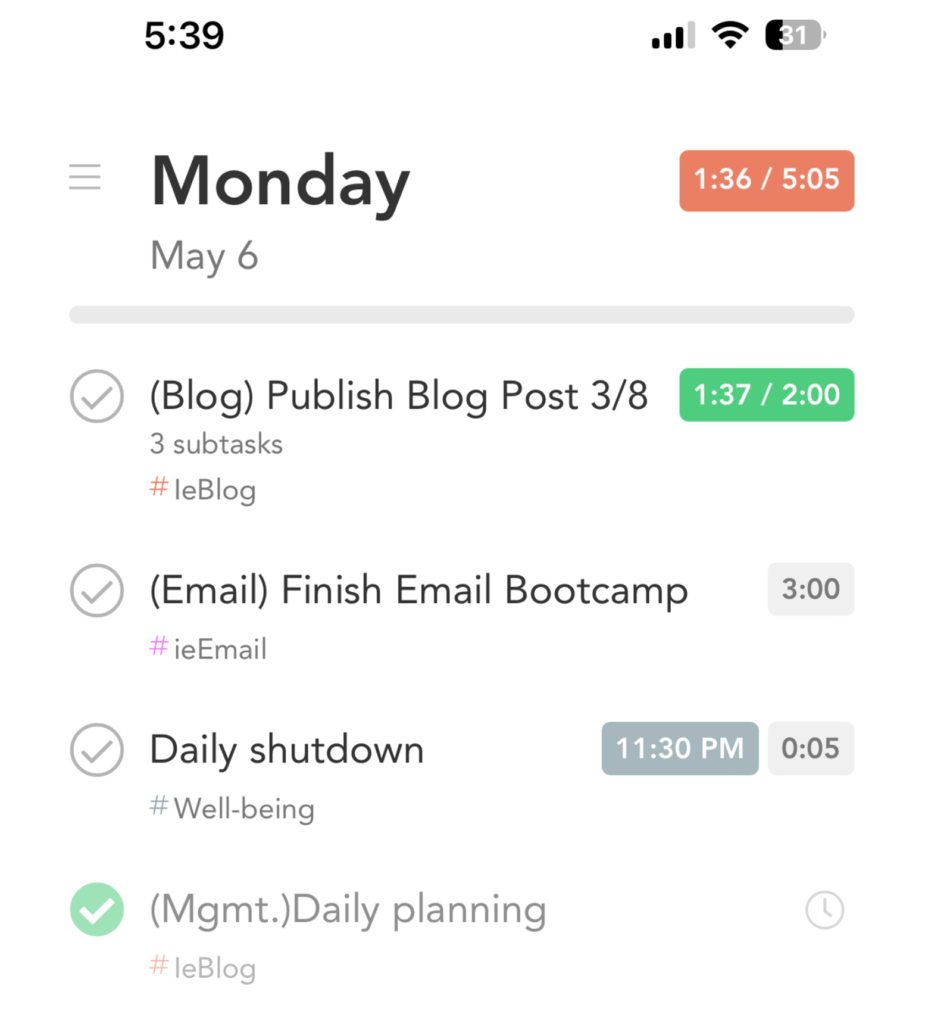
I’m a pen and paper woman and will always be, but this digital daily planner caught my heart within a few minutes of learning about it.
Click here to use it for free for one month.

Shifting to 12 week year mindset promotes intentionality.
You become intentional and accountable which means you put your goals first and you own up to your actions.
This is about making deliberate daily actions and making the most of your time. You cut out the noise, and you only focus on achieving your goals (while enjoying the journey).
By embracing this approach, you’ll tap into your full potential and start seeing impressive results in weeks.
You’ll achieve your goals; professional and personal goals in just 12 weeks.
Because why wait a whole year to see results?
Why do it in 12 weeks?
The answer is simple.
You’ll get more focused results and you’ll see significant results faster.
Instead of setting annual goals, consider breaking down your goals to achieve them within the 12-week period. It creates a sense of urgency and a ‘deadline effect’. which will encourage swift action and progress.
By treating each week as equivalent to a month, every day counts.
The 12-week year planning method promotes prioritising the most crucial tasks. Which will help you consistently focus on taking actions that are aligned with your goals.
Every week counts as a month, and every day is crucial, making it easier to maintain momentum and see progress quickly.
This is how I make every day count using Sunsama digital daily planner. I schedule 1 – 3 most important tasks and do my best to complete them. Thank you so much my beautiful friend Lindsay Kelly (the creator of Workflows and SOPs 101). I’m not surprised this tool reached her radar because she is a fellow productivity enthusiast.
What is 12-Week Year Planning?
A 12-week year planning is a planning method inspired by a book called 12-Week Year Book by Brian P. Moran and Michael Lennington.
I actually didn’t know about it until November 2023.
Thanks to Dr Fran Whitaker who introduced me to her Triple Goal Plan which helped me improve my goal-setting skills and productivity.
It was so long ago since I stopped planning my year. I only set yearly intentions and then do quarterly plan and review, then weekly plan and review.
But back in November 2023, Fran helped me set my 12-week goals. She introduced the 12 week year concept. I finished the first Cycle and I loved it since then.
I’m currently on Cycle #2 and it’s going to be finished by June 2024.

Prepare for the 12-week year
You can do the 12-week year planning any time.
Start in any week you’re ready to commit for a focus 12-week period.
Because I’m used to quarterly planning and doing a weekly execution, I prefer doing a 12-week year planning inside a quarter of a year. That means I still get about 4 of the 12-week year cycle the entire year.
I like to keep things simple, so when I had the first cycle of the 12-week plan, using Fran’s Triple Goal Plan, I did 3 things first:
- Got clear with my vision and core values
- Did a life audit
- Established 12-week framework.
Define your vision and core values
When I suggest conducting a life audit, I don’t mean for you to spend days thinking about your life. (well you could, if you want to).
All I’m suggesting is make time to do self-reflection. It’s up to you how long you want to reflect.
Where are you right now?
When you think of your life areas, such as life and home or family, career, love, finance and passion or creativity, are you happy?
Are you content or do you want something more?
So set aside time to do this. Create a space or a corner that’ll inspire you to self-reflect and think about what matters to you right now.
Get a journal.
You can also do a brain dump.
A neat idea is to create a task for self-reflection in Sunsama, and then use the Focus Timer.
The intention is for you to know which areas of your life you want to focus on.
When I did my first 12-week year, I assessed if the current focus areas I chose were still aligned with my bigger goals.
These are: Life+Home, Blog+Shops, and Well-being.
I realised that no matter the season of my life I’m in, I think these 3 life areas are going to be the consistent pillars that I’ll continue to nurture.
Establish 12-week year framework
I’ve been living one week at a time since 2017 so this part was easy for me.
A 12-week year framework is just thinking in weeks instead of months. This way, you compress the time and match your effort with it, so you can achieve your goals in less time.
Goal achievement in a 12-week year approach is more satisfying in my own opinion.
Because within 12 weeks you’ll see your progress. You get to reset and refresh when you do another cycle.
Here’s the basic framework I follow:
- Create your goals in different areas of your life
- Prioritise and align your goals
- Creating a 12-week action plan
Here are my life areas. (you can use them as examples)
Family and Home
This includes making my family, happy, connected and healthy. It also covers money mindfulness and home management.
Other examples of life categories you can use are: Physical, Personal, or Business, Spiritual, Relationship, Community,
Blog and Shops
This includes the intentionaleblog.com and the ieSHOP. I have Etsy but it’s now on the back burner.
Well-being and creativity
This is for me, and all about self-care, self-improvement and self-development.
And of course Bullet Journaling and spending creative moments with my kids. No matter how busy I am, I always have time to appreciate the creations of my kids like these 2 drawings. My son (Mr14) drew the flowers and my daughter (Miss8) drew Ponyo.


As for prioritising and aligning your actions with your goals, as well as creating a 12-week action plan, I’ll explain them a bit more when we get to the process.
12-week year process
Please note, that this 12-week year planning guide is based on how I implemented the lessons from the book (12 Week Year).
It’s also based on what I learned from Fran, back in November 2023 when she kindly helped me with my goal-setting process.
I applied what I learned by making a 3-step process that works for me.
- Setting your weekly goals
- Managing your tasks
- Execution with intention
Set your weekly goals
By now you already know the 3 areas of your life you would want to focus on in the next 12 weeks.
Those will be your goals.
Alternatively, you can think of one specific project you would like to complete. Then decide on 3 milestones that will complete that project.
Consider the following when setting goals for the next 12 weeks.
- What are the top 3 goals/milestones you want to accomplish by the end of the week period?
- Why these goals? What are your reasons behind those goals?
- Create an effective execution system where you’ll get closer to your goals
- Remember to think about the potential challenges and prepare. How are you going to overcome them?
Depending on your preference you can use analog or digital to set your weekly goals. Get your Free Printable Sunshine Weekly Planner here. If you like the Notion template, here’s the link to download your Free Notion Weekly Planner Template.

Living one week at a time
I’ve always loved this concept for so many reasons.
Try it if you haven’t.
It’ll create a significant change in your life in all areas. Plus it’ll allow you to be focused on your weekly goals.
When it comes to managing tasks on a weekly basis, it’s a good idea to have weekly accountability meetings either with an accountability buddy or a group.
At the beginning of each week, set your weekly goals. Then schedule daily tasks. Just make sure that each task moves you closer to your goals.
I maintain a list of tasks I want to complete during the week and prioritise them. Starting with the most important task is a game changer. I love that feeling when the important stuff is done first before I do other tasks.
Prioritise important tasks
Getting into the mindset of doing the most important task first makes me conscious of my time use.
So, I don’t touch social media until I get my top 3 tasks done. I keep my daily tasks in Sunsama. I love its minimalist and simple design. It helps me focus on those 3 important 3 tasks only.
Another benefit of living one week at a time is having a shorter time frame for adjustments when needed. Next week is another fresh start to set goals. You can refine your strategies and keep you on track.
Intentional Tip:
Here’s what you can do to live one week at a time.
1. Make time for regular weekly plan and review
2. Set daily intention
3. Maintain a daily log
In order to truly live your meaningful life, make sure that you’re not only consistent with your weekly planning for your 12-week plan but also with your weekly review. To be consistent with both planning and reviewing your weeks, you need to establish a weekly planning routine.

If you need help with creating your weekly planning routine, this is a good read.
Manage your tasks
The most important takeaway I got from the Getting Things Done Method by David Allen is doing the task and completing a project.
I learned that I can’t do a project, I can only complete them by completing tasks.
According to David Allen, a task can be completed by doing a single step while a project can be completed by doing more than 1 step.
No wonder “organising photos and documents’ on my laptop hasn’t been done in years.
I kept treating it as a task when technically it is a project. And because I thought it was a task, I always put it in my weekly tasks. But my brain always shuts down even before I begin to think about it. My brain thinks it’s hard work. (and it is), so “nah. not this time”. Then I just migrate it to another time.
Sample of breaking down tasks
So started breaking them into tasks such as:
- Delete photos while waiting for a train, or when I’m waiting for my turn during a medical appointment. I use every pocket moment I can find and delete photos.
- Go through the “keep” photos one more time and delete some more
- Save the “keep photos” in a folder organised by year
- Back-Up photos
- Continue the process and adjust if needed
And that’s how I moved forward my Photo Project.
Be intentional and be present
Use your time wisely. Be intentional about how you spend your time.
And most importantly, be present.
You can do this by truly focusing on the important task when it’s work time and enjoying your free time without guilt.
Manage distraction by practising self-discipline and setting your environment that supports focus.
You can manage interruptions by setting clear boundaries and communicating with the people around you.
Execute with intention
Set daily intentions.
At the end of each day, what would you like to accomplish?
This is one of the crucial steps in your purposeful execution.
Make a personal promise that you’ll take consistent action.
Check this tool which supports intentional execution.
Being Committed and Accountable
To achieve successful commitments during the 12-week year, it’s important to align your actions with your 12-week goals. Sustain your momentum by being committed instead of being motivated.
There’s nothing wrong with being motivated, it is a good thing.
However, being committed is more powerful because it’s a promise to yourself that you’ll do that thing no matter what.
Unlike when you act based on motivation- you only do the thing because of what motivates you, so it’s external. It’s common that when the motivations fades away, the drive to do the thing also fades away.
But if you’re committed you’ll show up, no matter what. One way of making sure you show up no matter what is making time for weekly planning and review.

Tracking progress
When you’re planning your 12-week year, don’t forget to make space for tracking progress. This is extremely important.
Your plan won’t be as effective as it should be if you miss this element.
Tracking progress will help you stay committed while building your confidence. Your progress tracker is a form of validation and confirmation that you are capable, of more than you know.
Here’s the list of benefits of tracking progress:
- You can celebrate your wins – small and big wins. This will give you the boost you need to keep going
- Learnings and lessons from what didn’t work will give you a chance to do better without being mean to yourself.
- Your progress will tell you if your actions are aligned with what you’re trying to achieve.
- Tracking your progress gives you a reason to keep the habit of doing weekly reviews.
Continuous growth and learning
Having a compelling vision, owning your process control, and your time management skills play important roles in achieving goals in shorter time frames,
Executing your 12-year week plan is an ongoing process so, be adaptable and flexible when changes need to happen.
The 12-week year planning is a cyclical approach where you need to appreciate the value of consistently pushing forward. The moment you stop pushing, you’ll stop learning and you’ll stop growing.
But push yourself with intention. Don’t overstretch yourself.
There’s only one of you.
So you need to keep yourself as healthy and as well as possible so you can do all the things you want to do.
What to do next?
The intention is to achieve your goals within 12 weeks.
So, go ahead and take your first step.
You’ve got this.
You’re one step away from making things happen.
If you haven’t already, go to Freebies for you Page and grab one (or both) of these planners


