7 Smart Budgeting Tips for low income Families
Whether you’re a single parent, a working couple, or a large family, the 7 Smart Budgeting Tips for low income Families will help you a lot.
Living by yourself and on low income too? I think these tips will also help you.
After all, it’s not always about how much you make, but what you do with what you make, right?
Creating a budget for low-income
Creating a family budget can be a daunting task.
If you’re a low-income family you’ll definitely feel the pressures that come from the feeling of not having enough.
Budgeting on a tight budget might feel like trying to stretch an already thin blanket to cover an ever-expanding bed.
Yet, it’s this exact situation where budgeting tips are not just beneficial but essential.
But once you’ve got control of your finances through intentional budgeting, that control of your money will not only help your immediate money goals but also your long-term goals.
Just a quick disclaimer before you continue…
I’m not a financial coach or a financial service provider. What I will share in this article is a combination of knowledge I learned from personal life experiences, from people in my life, and books I’ve read. What worked for my family doesn’t guarantee that the same will work for you too. Consider reaching out to financial advisors if you need professional help with your financial situation.
DISCLOSURE: This post contains affiliate links which means I earn commissions at no cost to you if you use those links to make purchases. See Full Disclaimer here
Making sense of your money
The first step is knowing your current financial situation. Establish awareness on where you are financially.
Do the following to have a clear picture of what you need to work on.
- Get your bank statements and take note of your earnings, savings, debts (and investments if you have).
- Check your bank account and make a list of your expenses, including all the unexpected expenses in the past. If you’re keeping an expense tracker, then it’s easy for you to know how much your monthly expenses are.
- Now, compare your income and your expenses. If your monthly expenses are higher than your expenses, then you can do 2 things. One: Reduce expenses or, Two: Increase your income. If you have debts, you need to prioritise getting rid of them while building an emergency fund. (my family calls this a Peace of Mind Fund)
Note: While completing the above 3 steps, please be kind to yourself.
If the numbers are frustrating to look at. It’s ok. Don’t make it too personal. Remember that your past financial decisions don’t define you. You’re doing something about it now. And that’s all that matters.
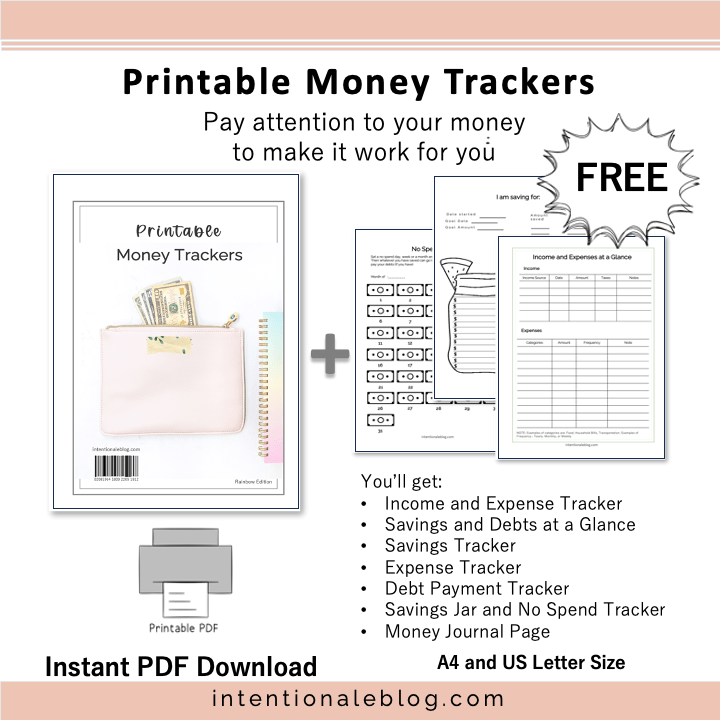
Here’s a free Printable Money Trackers. You can also click image below to download.
7 Tips on How to budget for low-income families
Your financial health depends on your money mindset, how you feel about money and your money habits.
To achieve your financial goals, Develop a Positive Money Mindset first. Then, Practise Money Consciousness to help you establish a healthy relationship with money and create abundance.
Unfortunately, it’s not enough that you only have a positive money mindset, you need to pair it with intentional and aligned actions with your goals.
And the best way to do this is to pay attention to your spending habits.
I hope that by implementing the 7 tips I’m sharing here, you’ll find managing money a bit easier.
1. Make it simple
If this is your first time budgeting, a great way to make it less intimidating or daunting, is to make it super simple. Use pen and paper and go analog style if you like. But if you prefer digital, you can use any budgeting app that you like. Pick the simplest and the easiest way to use. I can’t recommend anything, so sorry, because I only use my Bullet Journal and Notion for Money Management.
It’s not only the tools or the style that you need to apply simplicity. Your new budget needs to be simple too.
What do I mean by that?
Stick with the basics. It doesn’t matter if you’re creating a weekly, fortnightly or monthly budget.
How can you make it simple?
Just fulfil a simple purpose
– to have money for the essentials
– make room for splurge, nice to have and non-essentials
– to be debt-free
– have savings for short-term and long-term savings goals
2. Prioritise the Essentials
I understand that if you’re on a low income, you might feel that you don’t have enough money.
But there’s something you can do about it and you can make it work. Believe that you can. You can practise Money Consciousness or use Powerful Money Mindset exercises to help you make it work.

Prioritise the absolute essentials – these are your basic needs. I can’t tell you what the absolute essentials for your family, but I can give a category that you may use as a guide.
This is the actual essential expense category, and expense items that I use in my family’s cash position. (also known as budget, I just prefer to use cash-position or cash-po)
I don’t like the word budget. The only reason I use it is it’s more relatable for other people and it’s the term that everyone will understand.
Essentials Expenses:
- Housing costs (Rent/Mortgage)
- Health Insurance /Life insurance
- Education (this includes school fees and other school expenses, and extracurricular activities for the kids; such as swimming and soccer
- Food /Groceries
- Transportation/Car repayment/Public transportation
- Sanity Fund – A set amount of money that you’re free to spend any way you want
A couple of notes:
When my husband had credit card debt more than 10 years ago, Debt Payments were included in the list of Essential Expenses. So if you have debts you can include that in your Essentials too.
If you’re wondering what the Sanity fund is, this is simply an assigned amount that we can spend to splurge, for nice to haves, and for fun/leisure. It’s basically a specific amount that we can spend however way we want.
3. Eliminate Debts
I know, I know….
You’re probably thinking…
“The reason why there’s debt is because of low income. So how is this going to work?”
I appreciate that this can be hard but, you just gotta face the fact that you do need to pay that debt. And you need to start doing this as soon as possible. Yes, even if your income is low.
Don’t worry, you’re not going to do it painfully.
Baby step, my friend.
You can practise Intentional Spending or perhaps do a No Spend Month every couple of months. These two practices can help you cut back on expenses and save money. Any saved money can then be redirected to paying off your debts.

So after you have listed all your Essentials Expenses, make another list.
This time it will be for all the Non-Essentials like streaming services, unessential household items, nice to have school supplies,
To begin eliminating debts, look at your non-essentials and let go of what you can let go. Pretend that you’re still paying for them, but instead of actually paying for them redirect the money to debt payments.
And don’t underestimate the amount. Even if it’s just $1, recognise that it is as important as $1000.
Then all you need to do is keep reassessing your situation as you go and keep adjusting your non-essential purchases.
When you get your take-home pay make it a habit to make time and manage it. Track and allocate money accordingly.
4. Build Emergency Fund
An emergency Fund is an account reserved for unexpected expenses.
My family call this the Peace of Mind Fund. The idea is to have a ‘ready to use” money in case something unexpected happens. If the car breaks down, or if a household appliance stops working, the Peace of Mind Fund will take care of them.
The easy way to do this is to create a separate account for a Peace of Mind Fund, if your bank allows you to have multiple accounts.
Then start allocating an amount to deposit to this account regularly. Even just a dollar is perfect at the beginning. Just keep building it by topping it up regularly. And make sure that you’re only going to use this money for “genuine” emergency expenses.
It’s also a good idea to have a side hustle if you can do so. Income from a side hustle can help you build your Emergency Fund faster.
It has been a long time since the very first time I set up our Peace of Mind Account- (Emergency Fund). It was more than 11 years ago now. Since then, I’ve updated and streamlined our budgeting method but the idea is the same and the strategy is the same.
The purpose of Emergency Fund is to have peace of mind when something unexpected happens. You have money ready to use and you don’t have to rely on credit cards or getting a loan.
This is also one of the reasons why we’re able to successfully live debt free for more than 13 years now. We don’t rely on credit card.
In the beginning, it was really difficult because we were on low income, and only one of us was working.
Here are a few tips if you want to build an Emergency Fund.
- Set a target amount for your Emergency Fund. In our case, I set it to $3000 initially. Currently, it is set to the amount equal to 3 months of our monthly income. This way, if something happens and one of us cannot work for 3 months, then the basic needs and household expenses are sorted
- After setting the Peace of Mind fund, I scheduled an automatic transfer to this account. It started from $5, then $10 then it became $20 to $50. When I got a job that made us a 2-income household income, I increased the amount a lot until we reached the desired amount.
- Every time we get unexpected money, for example, a bonus, or savings from a purchase. When we budgeted for an item and we ended up paying less, the difference was directed to the Peace of Mind Fund. Any extra money we get goes to the Peace of Mind fund.
Doing a No Spend Month is also a great way to build an Emergency Fund. Here’s How to Successfully Complete a No Spend Month.

5. Track your money
If you only need to pick one thing from this list of tips, take this one and implement it right away. (That is of course if you’re not doing it yet).
Make it a habit of tracking your money regularly. Do the tracking however you like. What matters is you’re tracking it and you’re aware of your cash flow.
You can use a physical money tracker like the Free Printable Money Trackers or you can use your Phone Notes app if you want to go digital. You can also use Google Sheet or Notion.
Keeping an eye on your money is important. It helps you know exactly where your cash is going so you stay in control. You can plan better for things like saving up or investing.
When you track your money, you’ll spot overspending and you can fix it real quick. You can immediately practise mindful spending or do a no-spend month challenge.
Tracking your money promotes awareness so you’re more in charge and less stressed about your finances.
And if you’re budgeting or trying to pay off debt, tracking is the key to keeping you motivated and staying on track.
6. Embrace Intentional Living
Intentional living is the conscious practice of making deliberate choices that align with your values, goals, and priorities.
It means you’re mindful of how you spend your time, energy and resources to create a life that’s meaningful and fulfilling. There are so many lifestyle choices you can choose that will help you when you’re on low income.
Here are some examples of those lifestyles.
- Frugal Lifestyle
- Minimalist Lifestyle
- DIY lifestyle
- Off-grid living
- Secondhand lifestyle
- Remote Work Lifestyle
Some of these lifestyles crossover with each other.
I also want to point out that intentional living and the other lifestyle examples above are not only meant for families or individuals who are on lower incomes.
They can also be for anyone who wants to create and live a meaningful and fulfilling life by being purposeful.

7. Stay Committed
Money management is a hard job, but the more you practise it the easier it becomes.
In fact, you might even find it really fun. I’ve always loved managing personal finance even before I got married and had kids. It was not for anything else but to thrive.
I moved out of home as soon as I could and at a young age, I learned that it’s not about how much I earn. it’s what I do with what I earn. I’m grateful for my Mother who has been my model and inspiration for being wise with money.
So set goals. If you have kids, they are never too young to learn about Money Mindfulness. Teach them about money as soon as they can say the word money.
My husband and I have 2 kids – a 14-year-old boy and an 8-year-old girl. Both of them are very good with money and understand money mindfulness. I can’t tell you enough how helpful this is. Having all family members on board when you’re practising money consciousness is such a great advantage.
Stay committed and show up for your financial goals no matter what.
One way to stay committed incorporating your finances when you do your weekly reviews.
You can make things happen by practising weekly review.
What to do next?
Your next step from here is to set aside time for money management.
Make time for your personal finances.
If you’re new to managing your personal finances, you may need a little extra time.
But don’t delay. Schedule time so can pay attention to your money.
Here are some blog posts with tips, guides and ideas to help you do that. It’s a lot. So consume them with intention.
Take what resonates and leave the rest. Don’t feel the need to implement everything you’ll learn.
One idea, one tip, at a time.
Learn the 5 ways to intentional money habits
This is your guide to money consciousness
Try intentional spending to manage your budget
Here are the 77 Financial Affirmations to practise Positive Money Mindset
You got this.
Don’t forget your Free Printable Money Trackers, it’s here. You can also click the image below