
How to Successfully Complete a No Spend Month Challenge
In 2010, my husband had a 5-figure credit card debt.
We paid it off in just over 2 years.
On one small salary and with a 6-month-old baby.
We did it without selling our souls, eating so poorly, and being deprived.
Do you want to know how we did it?
We did a lot, and one of them was to have a ‘lean period of time’ such as a no-spend month.
If you’re interested in trying it and want to ensure your success, keep reading.
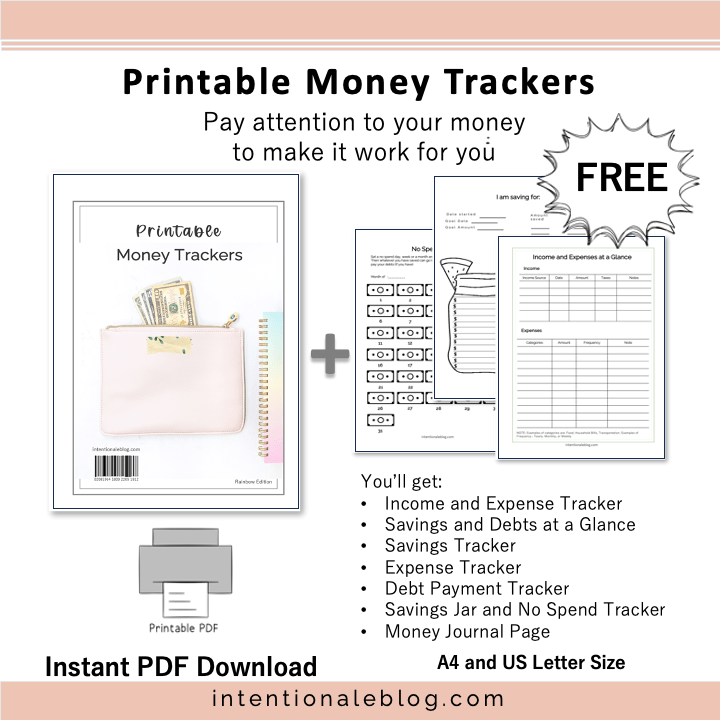
Before you continue, have you gotten your free money trackers yet? You can download them here or click the image below.
One more thing. A quick Disclaimer in the name of transparency.
I’m not a financial coach or a financial service provider. What I will share in this article is a combination of knowledge I learned from personal life experiences, from people in my life, and books I’ve read. What worked for my family doesn’t guarantee that the same will work for you too. Consider reaching out to financial advisors if you need professional help with your financial situation.
DISCLOSURE: This post contains Affiliate links which means I earn commissions at no cost to you, if you use these links to make purchases. See Full Disclaimer here.
No spend month and intentional living
It may or may not be obvious but no spend month is very much related to intentional living.
No spend month (my family calls this a no-spend project) aligns with the principle of intentional living as they both emphasise intentionality, purposeful decision-making, and aligning actions with values and priorities.
Doing a no-spend month supports your intentional living in at least 4 ways.
- Encourages mindful consumption instead of impulse purchases.
- The experience lets you focus on your values and align your actions with your financial goals.
- Promotes Simplicity and Minimalism by simplifying consumption and avoiding bad spending habits
- Helps you experience financial consciousness by being aware of your good and bad financial habits
In essence, a no spend month project serves as a practical exercise in intentional living, giving you space and time to pause, reflect, and realign your spending habits with your values and priorities.
You get to practise mindfulness, simplicity, and financial consciousness.
If you want to do no-spend month successfully, you also need to create and build intentional money habits.
Highlights your Core Values
Obviously, you need to know first your values before you start a no spend month.
Then, you can reassess your spending priorities and ensure that your daily financial decisions are aligned with your financial goals.
Specific goals like savings goal reserved for the holiday season or a specific amount you want to set aside for holiday spending.
By choosing not to spend on non-essential purchases, you can redirect your resources toward activities and experiences that bring you joy and fulfillment.
Promotes Simplicity and Minimalism
A no spend month project will help you consider simplifying your consumption habits by reducing unnecessary spending.
It helps your bank account, well-being, and mental health too.
By intentionally limiting unnecessary purchases you’re cultivating an attitude of gratitude.It’s a part of a positive money mindset, that helps you lean more on contentment with less, and appreciate the abundance you already have.
Encourages Mindful Consumption
A no spend monthly challenge (or a no spend project) will prompt you to pause, and reflect on your spending habits, so you’ll have a deeper understanding of your needs and wants.
It’ll help you consider making conscious, and intentional choices about your purchases, and where you allocate your financial resources wisely.

Supports Financial Consciousness
Doing a no spend month project nurtures financial awareness and supports financial consciousness.
By being aware or conscious of your finances, you’re able to evaluate your spending patterns and then find alternative ways to meet your needs without spending much money. Something you might not have considered if you weren’t money aware.
You’ll also develop a deeper understanding of your relationship with money: which will help you more informed financial decisions in the future.

What is a no spend month?
You probably heard people do the Savings Challenge and No Spend Challenge.
A no spend month is committing to not spending money on non-essential items for the whole month.
A no spend month is one of the variations of the No Spend Challenge.
Other no spend variations are:
- no spend day
- no spend week
- no spend month
When to do it is entirely up to you.
A lot of people do a no spend January, but honestly, you can do it at any time of year. Any month you choose to do it is a great time.
We first did no spend days in 2010, became debt-free at the beginning of 2013. It started with no spend weekend which we used to call “lean weekends”.
And since then, we only do this project every now and then when we need to do a financial reset.
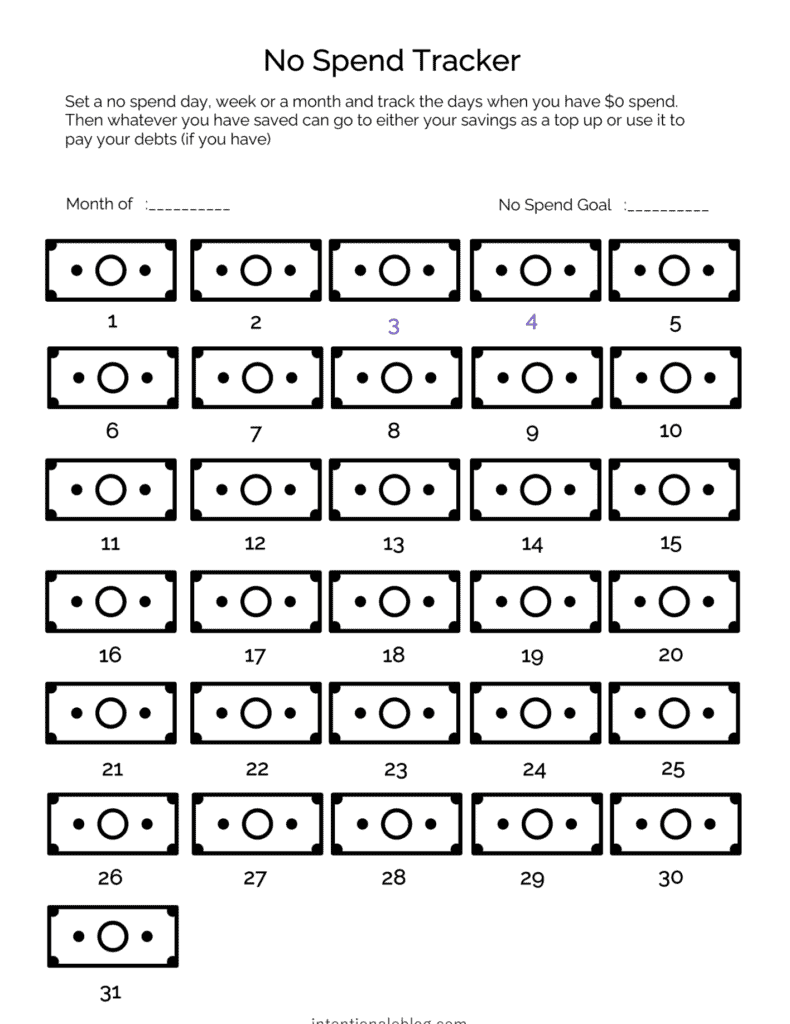
Want this no spend tracker? Download your free money trackers here.
Why you would want to do a no spend month?
Well, you can do a no spend month to:
- Save money. The extra money you’ll have can be redirected to other more meaningful financial goals such as travel.
- Start an Emergency Fund (a fund dedicated to unexpected expenses) Note: I don’t use the term “emergency fund”, I use “Peace of Mind Fund”.
- Do a financial reset to improve cash flow. A great way of improving your cash flow is by reducing your outgoings. For example: slashing the grocery budget.
One of the best benefits of doing a no spend month is boosting your savings goals.

Common misconceptions about no spend month
Before you start doing the challenge. Let’s talk about common misconceptions first.
- “No spend” means complete deprivation
- It’s too restrictive and unsustainable
- The no spend month or no spend challenge is only for people with financial difficulties
You don’t need to deprive yourself
If you’re afraid to try a no-spend month challenge, because it looks like you might need to be in a total deprivation mode, please don’t be.
The goal of the challenge is not to absolutely eliminate all your expenses. Instead, the intention is to prioritise essential expenses, and minimise discretionary spending.
You can still pay your utility bills, transportation, and medical necessities. And yes you can still go to a grocery store to buy food. However, some people challenge themselves to not buy groceries and use up what they have instead.
The real challenge is to cut back or not spend on non-essential purchases.
It’s not restrictive and it can be sustainable
It’s definitely not restrictive or unsustainable. Remember, you can make your own rules.
It’ll only be restrictive and unsustainable if you let it.
I suggest, do a no spend month every 3 months. You can even consider once every 6 months, it’s just depends on your financial goals.
A no spend month is only a temporary exercise to raise financial awareness and encourage mindful consumption.
The extra money that comes with it, the creativity you thought you didn’t have, and the contentment are just bonuses.
You don’t need to be struggling with money to do it
We’ve been debt-free for more than 11 years now.
But I admit.
When we first tried the no spend challenge, it was because we badly needed to stretch our dollars.
But as we embraced money mindfulness and develop our a positive money mindset, we slowly realised that it’s actually a really fun project.
You can certainly do this even if you’re not struggling with money.
Try it, even if you just want do a financial reset or try the intentional approach to spending.

Preparing for a no spend month
At this point, I think you’re ready.
The very first step is to decide what month you would like to do it.
My family do this when :
- we just got back from a holiday (a travel or vacation)
- unexpected happened in the previous month
- special occasions finished
- we want to top up our Peace of Mind Fund (Emergency Fund)
- we are doing a financial reset, and
- when we want to boost our savings goals.
So, gather what you need, and let’s get started.
You’ll need a few things:
- bank account information so you can see your numbers. This is just for clarity so you know your current financial situation.
- A journal to record your experience (optional)
- No Spend challenge trackers (highly recommended) and I encourage you to use physical trackers for this.
At the very least, you must know your income and expenses. This will help you decide the best goal for your no spend month challenge.

How to do a no spend month
There are 3 main parts of the process:
1. Reflection and Goal Setting
2. Creating a realistic Budget (I call this cash position)
3. Take action. Just execute (Includes daily or weekly review for tracking progress)
1. Reflection and goal setting
First things first.
Assess your current spending by doing a quick reflection. And then you can set your intentions and goals. Use these free Printable Money Trackers or click the image below.
Reflection
It’s important to do a quick reflection before the challenge.
You can do it in just 3 easy steps.
- Track your expenses before doing the challenge
- Review your spending patterns
- Evaluate necessities and discretionary spending
Track your expenses and assess your current spending pattern.
NOTE: THIS IS ONLY TO GATHER DATA. This is not the time for you to judge yourself with the past financial decisions. So be kind to yourself.
Notice if you have been doing emotional spending.
Have you been online shopping a lot? If yes, find out the reason.
It’s a good idea to have your expense tracker filled out, a month before you do the no spend challenge. But if you don’t have it completed, it’s ok. Just go back to your bank statement and work with what you have.
When it comes to evaluating your needs and wants, I will not tell you what should be in the “need” or “want” categories.
Only you can determine that. Just trust your judgment. Remember, it depends on what matters to you.
Going to coffee shops a couple of times a week can be non-essential or in the “wants” category for other people, but for me, it’s essential.
And while buying my favourite coffee in my favourite Cafe is a necessity, buying something on impulse even if it’s 90% off is a no for me.
Just because something is heavily discounted it doesn’t mean you’re saving money.
If you buy something that you don’t need (say it’s $20 now instead of $100). You didn’t save $80 there, you wasted $20 because you didn’t need the thing in the first place.
Intention and goals
The Intention
Your intention is the mindset and the attitude you would like to embrace by doing the challenge.
Let me explain a little bit further. My family calls this a “project” instead of a “challenge”, even though technically it is a challenge. It’s just swapping words but it makes a difference.
If you view it as a challenge, there might be some resistance in your mind. A challenge isn’t easy, we all know that, right?
Side note: A project is something you’re working on that has a “beginning and an end”. This is by far the best definition of the word that makes sense to me. Thank you Tiago Forte, the author of Building a Second Brain.
So, if you use “project” instead of a “challenge” it feels a little lighter. Suddenly it doesn’t feel like it’s a high mountain you have to climb. Rather, it’s a journey you just need to experience.
The Goals
The Goals are the actual tangible outcomes or results you want to get out of the no spend month project. What would you like to achieve at the end of the month?
For the full month of making intentional financial choices, what would you like to feel? Hint: you can achieve financial resilience, be content with less, find your creativity, and maybe be happier.
If you find you have been buying non-essentials, then maybe your goal could be to reduce impulse buys.
2. Create a budget or a spending plan
But before you do.
Practise gratitude first.
To be honest, it is safe to say that you have everything you need. Sometimes, you just don’t take notice.
If you have a roof over your head, you have food on the table and a source of income that supports your lifestyle, then you have all the essentials.
Everything else is a nice to have. Consider being content with less, and appreciate the abundance that you already have.
Make a simple budget
The simple the budget, the better it is.
A simple budget is a plan for your money.
Figure out how much money you have coming in. Consider all the resources: regular and irregular. Then assess your expenses both essentials and non essentials expenses.
The intention of making a budget is to make sure that you don’t spend more than you earn. And that you have savings for short term and long term needs (and wants too)
After creating a budget, set the rules.
Let me share our 3 Rules during no spend month. You can use this as your inspiration.
- A. The no spend rule doesn’t apply to “essential expenses”
- B. No unplanned or impulse purchases
- C. Be organised, creative and resourceful
Rule A: Spend on genuine essentials only
Whenever we do a no spend month, Essentials are exempted.
The exemptions are:
- Grocery expenses up to the maximum assigned amount per week.
- Medical bills when needed
- All household utilities (we already have this set aside in advance at all times)
Note: We have a separate account called “Peace of Mind” so when we need to pay for any of the above, except for grocery bills, we just pay it from the Peace of Mind Find.
Rule B: No unplanned or impulse purchases
During the no spend month, we don’t spend on nonessential items.
Anything that doesn’t fall under any of the categories under Rule A, will just have to wait. But we do take note of the item and see if we still want it next month.
So no new clothes, Yes even if it’s 90%off. This is hard to resist I admit. But a new clothing or new shoes are not emergency needs.
Rule C: Be organised, creative and resourceful
Being organised, creative and resourceful is no doubt a great contributor in making a no spend month a big success.
Here’s why.
You can save money by being organised.
If you make time for meal planning, you can reduce buying takeaway food. And if you’re organised with your utility bills then you’re more likely to avoid late fees and unnecessary charges.
You’ll also save (and earn) money by being creative and resourceful. The following ideas will surely enhance your creativity and resourcefulness.
- Embrace the beauty of DIY if you have time and capacity
- Repurpose, recycle, and upcycle
- Meal plan and batch cook
- Appreciate free things and low-cost activities
- Set a period for purchases of more than $500 before buying it. (We do 7-day rule. If we want to buy something (non-essential) and it costs between $200 to $500 we wait for 7 days to see if we still want/need it).
- Swap or borrow instead of buying
- Implement energy-saving measures
- Grow your own food if you have the skills, space, and time
- Find a side hustle
- Don’t save your credit card information to avoid “quick check out” online. Make it a little harder to check out.
- If you drink, maybe do it during happy hour so you can still have a good time while spending less money. (I don’t drink so I don’t really know much more about the happy hour thingy, so do your research.)
- When buying groceries, check if it’s better value to buy in bulk, for example, a bigger pack of toilet paper is usually cheaper by the unit than buying small packs.
- Be creative, and find savings even on small items, because everything adds up in the long run
- Find a side gig. My side gig is blogging. Check out the best tools for the intentional blogger here.
Execute your plan
There are only 3 things I would like you to remember when it comes to executing your plan.
- Make sure you’re prepared before the no spend month
- Check if your goals are clear and simple enough. The most important thing is, your goals need to be aligned with your core values.
- Just do it. Follow your plan.
Stay accountable
To stay accountable when doing the no spend month, you need:
- to set clear goals
- create a realistic and simple budget
- track your progress
It’s essential to track your progress regularly.
Set a schedule for reflection, the set period of time is completely up to you. You can do it daily or weekly. And then at the end of the month, do one big reflection for carrying lessons forward and appreciating the experience.
The best way to keep yourself accountable is to incorporate your no spend month reflection during your weekly planning and review.

What to do next
You’re one step away from reshaping your spending habits.
Treat the no spend month challenge as an important part of your Money Mindfulness Journey. Let it support and enhance your intentional living lifestyle.
Do it every other month or whenever you want to do a financial reset.
I’m so excited about all the many meaningful financial goals you’ll achieve, by implementing what you’ll learn from your experience, while doing a no spend challenge.


