
A step by step guide on how to do a Time Audit
What if I told you that you can make more time just by doing a time audit?
Can’t believe it?
Keep reading and follow the step-by-step guide on how to do your own time audit.
You’ll make extra hours or bonus minutes that you can use for meaningful activities. Activities like doing tasks to grow your business, spending more time with loved ones, and making time for self-care.
DISCLOSURE: This post contains affiliate links which means I receive a commission at no additional cost to you if you click through and make a purchase using those links. As an Amazon Associate, I earn from qualifying purchases. See my full Disclaimer here.
What is a time audit?
A time audit is an activity where you track what you do with your time.
The idea is to find a clear picture of where your time goes.
It’s commonly done on a specific time period. You can do a daily time audit, a 3-day or a 7-day time audit.
It’s simple to do. Decide on the specific time or day you’ll start. Choose your tool, then start tracking and recording what you do at a specific time. It can be analog or digital.
I do time audits regularly, so sometimes I do it in my Bullet Journal and sometimes in Notion.
Click here and discover how great Notion is.

The challenge with tracking time
Have you tried doing a time audit before?
If it didn’t work for you, I hope you’ll give this exercise another chance.
I have no way of knowing why it didn’t work for you, but I can give you the common challenges and how to deal with them.
Negative connotation
The word “time audit” can sometimes have a negative connotation.
It can give the impression of being overly critical, as if someone is closely watching and judging your choices with your actions.
You might even feel, that every minute of your day, is being tracked, to find out if you’re using time wisely.
Strict
Doing a time audit seems strict. There’s a discomfort in discovering your unproductive habits, or when you’re confronted with the reality of how you spend your time.
However, the moment you get past that discomfort, you’ll be on your way to a positive change.
Daunting
Time audit can be daunting, if you do it without clear purpose. So this time, do it consciously and with a meaningful intention.
Pretend that you’re just writing in your diary about your daily schedule.
Track your activities, with only one purpose, and that is only to record. No analysis and certainly no judgment.
Think of a time audit as an experiment, and a fun and enlightening experience.
Honestly, no one is going to punish you, if your time audit shows that you’ve spent 3 hours scrolling on social media. Or you spent 2 hours doing things that weren’t even related to your goals.
After doing a time audit and you discovered something shocking like that, pause for a minute. Let yourself be disappointed for a little bit if you have to. But after that, appreciate the fact, that you can always make new goals.
It means you can adjust your working time. Focus on the most important things first, before you do the potential time wasters. And this time, you’ll set a time limit.
Be conscious and present.
It will only take a few seconds to pause, and check if what you’re doing is pushing you towards your goal or pulling you away from it.
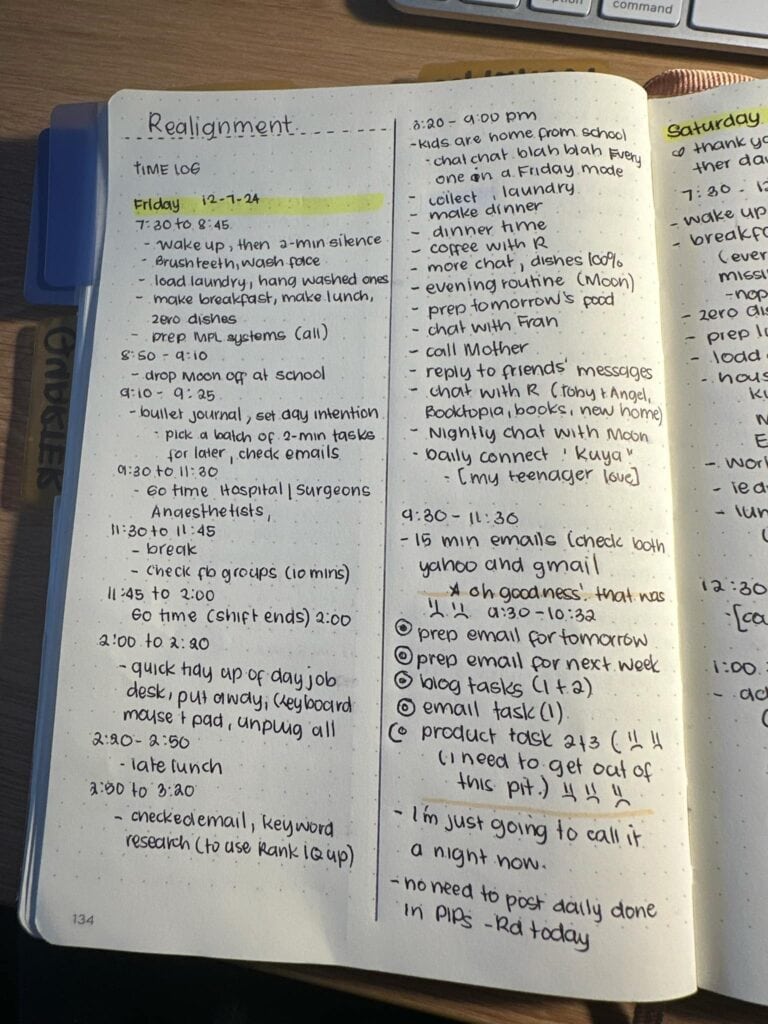
Here is my most recent time audit ( I sometimes call it a time-log).
Benefits of tracking your time
You don’t need to track your time forever. And you absolutely do not need to track your every waking moment.
I’ve done this many times since 2021 and I’ve done it in different ways too.
And regardless of how I did it, I always get 3 benefits every time.
- Awareness
- Clarity
- Boost in Productivity
Key benefits of doing time audit
Establishing Awareness
Time audit cultivates awareness, letting you know where your time goes. So, you’ll never have to wonder where the time went. You get to discover your habits and behaviour patterns.
Getting Clarity
A time audit clarifies how long you spend on a certain activity. And when you look at it as a whole, you’ll understand what activities are pulling you away from your goals and what are pushing you closer to your goals.
Optimise and boost productivity
The time audit exercise also helps you improve your time management skills that boost your productivity. It gives you a better idea of what activities bring value to your life.
Sometimes I do time log in Notion too. I do this when I want to a granualar approach.

A personal experience
In my last time audit, I discovered how important it is for me to use a timer. I can be lost and get buried in whatever I am doing so easily, especially when it’s fun for my brain.
I can work for hours and hours reorganising my dashboards in Notion and doing housekeeping in my work space. And if I don’t have a timer, I will end up doing just that, which will hurt my producitvity.
Knowing that not having a timer can hurt my productivity, I can now make a reminder to set a timer first before I do anything. And as a result, the next time I do fun task, I’ll make sure I have a timer set before doing so.
Why Should You Perform a Time Audit?
Oh there are so many reasons why you should, but let me give you one the most important reasons.
Awareness…
Let me explain by sharing a personal experience.
The first time I did a time audit was in May 2021.
It was uncomfortable because the habits and patterns I discovered were either embarrassing or frustrating.
“What? I spent 2 hours a day scrolling Facebook, I wasn’t even commenting or liking, just scrolling and reading posts that caught my interest.”
“I spent 4 hours in the kitchen cooking?”
“Unbelievable. I spent 1.5 hours cleaning every day?”
And the realisation that woke me up – I only spent 35 to 45 minutes every night with my kids.
That information made me realise that even though I spent focused time with my kids, it was way less than the time I spent cooking, cleaning, and on Facebook.
Time audit effect
So, in May 2021, I stopped using Facebook for personal purposes. I kept my account open but only for the purpose of being in the communities I’m in.
Just to be clear, I’m not against social media, I just don’t have the capacity for it and I prefer SEO and Pinterest over FB.
I don’t know about you, but there are times when things would only make sense to me when they are written down.
So when I tracked what I did every hour for a week, the time tracker slapped me with a painful reality. I knew what’s important to me – my kids and husband- but my action didn’t reflect that.
So, I had to change something. And that was to use social media with intention.
What Tools Do You Need to Run a Time Audit?
When it comes to the tools to use. You can choose between digital and analog.
And if you’re a regular guest in this website then you know I’ll say choose analog.
Because there’s power on writing things down.
But of course the best tool is what fun for you to use. Analog or digital, it doesn’t matter.
Here are the list of tools you can use
- pen and paper. I use bullet journal and when I feel going digital, I use notion because it’s my most favourite all in one tool when it comes to productivity and life organisation.
- Printable Time Audit Tracker – saves you from writing down time and date
- Google sheets
- Sunsama
You can also use Toggle, I’ve used it for a bit but I always come back to Notion or Bujo.
Click this link to start your free trial with Sunsama.

Daily vs Weekly Time Audit?
Now that you have your tools ready, it’s time to decide whether it’s better to use daily or weekly time audit.
I prefer daily time audit and in 3-day chunk at a time. Depending on productivity meter, I do time audit every 2 weeks or once a month.
If my daily done list tells me that I’m doing more of low impact tasks instead of high impact tasks, then I do time audit.
Both approaches have their merits, so it’s essential to consider your lifestyle and your goals.
A daily time audit offers real-time insights into your daily activities and allows for quick adjustments.
On the other hand, a weekly time audit provides a broader overview and helps identify patterns and trends.
Choose the frequency that works best for you and your goals.
How to Do a Time Audit
This is it, the part that you’ve been waiting for.
So get your tool of choice or at least have a note pad or a piece of paper to brainstorm.
Ready?
Let’s do this thing. (I said that as if we’re about to do something really, really big).
And I think this is big because you’re about to discover how you can optimise one of the most important resources – TIME.
Step 0: Preparation
Before starting the time audit process, you need to set the stage first. Focus on your Mindset and the purpose of doing the time audit.
The Mindset
Mindset is everything.
You can do everything right but if you’re mindset isn’t right, things can be difficult because of the disconnect.
So examine your mindset first, and think about how you feel about this whole time audit thing.
Approach time audit with curiosity and with an open mind.
Be ok to with the discomfort when you discover you’re doing things that don’t add value to your life.
Accept the discomfort if you find out, that you somehow developed unproductive habits. It’s more likely that you genuinely didn’t know about it.
A positive mindset is the foundation of a successful time audit.
The Goal
Reflect on your motivations and envision the positive outcomes, and the benefits you’ll enjoy after the audit. Remind yourself that this is a journey towards self-improvement and that every step counts. Embrace self-compassion and celebrate small wins along the way.
Set a Goal that when you achieve it, you’ll more likely to make time audit a part of your productivity system.
Because the more you do time audit the more awareness and clarity you’ll get. And these two are the keys to making the most if your time.
So what’s your goal?
I encourage you to think about setting a goal that is a goal for you, and only you.
And I’ll give you some ideas but only use them as example
The goal of a time audit can be:
- identify activities that don’t add value to your life
- check if a certain activity pushes or pulls you away from your goal. If the activities push you forward then you can treat them as important tasks, and if they pull you away from your goal, then you can spend less time on them.
- create a balanced schedule where you have enough work hours as much as free time for recharge and reset
- make time for what matters by eliminating time-wasting activities
- identify habits, patterns, and different tasks where you can make adjustment to optimise your time, so you can focus more on high-priority tasks
- better work-life balance
Decide the tool you’ll use. Pick only one tool for now and you can try another tool the next time you do you time audit again.
Step 1: Plan

To make the most of your time audit, the first step is to have an action plan.
I’ll share with you my 3-step plan
1. [The Goal] Think of something important to you. A goal, a project or an idea that you always wanted to do, but you never got around to doing it because you don’t have enough time to do it. If you’re a blogger like me or you have a side gig, think of how many hours you want to spend more on your blog or business.
Your goal could be – To find extra time that you can use for more meaningful activities.
2. [Focus Area] Identify the key areas you want to focus on and set specific goals for those areas. (related to step 1). The key areas can be about a goal or project for your personal life. If you have a day job or a side hustle, you can also focus on having a healthy work-life balance.
3. [Time] Choose the duration or specific period of time when you’ll do the time audit. It can be just for a day, if you’re starting or 3-days at a time. But to get an accurate picture it’s best to do it in a 7-day period.
Step 2: Start Tracking
Ok. So far you’ve got the goal, you know your focus area, and you’ve decided of the time period (one day, 3 days or 7 days).
The next step is to start tracking.
Create a time log.
A time log has a specific time, an actual time frame (start time and end time), that shows what you do in that time. It can be work-related projects, work-related activities or personal time activity.
It’s a simple as taking note of the time period (from x time to x time) and noting what you’ve done in that set period.
You can put additional information too. I like inserting “my current thoughts” in my time entries.
If remembering to do it is a challenge, I suggest to keep your tool close to you and set manual alarm to remind you.
Capture every activity you do whether you’re doing deep work or your regular to-do list.
Step 3 – Reflect
Reflect and make adjustment for later.
Once the time audit period is over, take time to reflect on your findings.
So if you chose to do it for a day period, make time for the next day to reflect. If you did a 3-day or 7-day time audit, make time on the 4th or the 8th day to reflect.
Analyse the data, identify patterns, and evaluate the effectiveness of your time allocation. Celebrate your successes and acknowledge areas for improvement.
Use this knowledge to make informed adjustments in your daily routine and maximise your productivity. Armed with insights from your time audit, you can now adjust your approach in doing your daily tasks or project management approach.

Celebrate and move forward
Now that you know more about time audit and you even have the 3-steps guide on how to do it.
Go ahead and pick a date when you’ll start doing a time-audit.
This is such a significant step you can take to make the most of your time and be intentionally productive.
Time audit will give you precious insights that will help you identify habits and areas for improvement.
Use those insights as your guide the next time you make your weekly plan, prioritise your tasks and create a health balance between work and creativity.
Before you go.
If you haven’t already, grab your free weekly planner in the Freebies for You.


