
Getting Things Done: Simplified

Hey Busy Bees.
In my post How to be Intentional using the Bullet Journal Method (Bujo), I explained how Bujo helps me track my past, sort my present and plan the future.
Today, I am going to share the ultimate partner of the Bullet Journal Method (Bujo). Getting things Done method by David Allen.
Why am I sharing this?
There are a lot of reasons, but I will focus on the 5 most helpful benefits I get from using this method.
- Reduce Stress
- Manage to-do list effectively
- Focus on what matters
- Stay motivated
- Get things done
I discovered Getting Things Done (GTD) by David Allen in 2015. It took me long to finish reading and understanding the book but it was all worth it. More about this a little bit later.
Does any of these resonates with you? If yes, then this post is for you.
- Before using GTD method, I used to struggle with mental and physical clutter
- I used to have too many list but I still found myself spending too much time searching information from my lists.
- Scattered thoughts, ideas and stuff used to make me feel overwhelmed. As a result, I used to procrastinate a lot.
- Being present whether with people or a task used to be a huge struggle.
- I used to believe that multitasking was the way to go if I would like to accomplish more. I was so wrong.
DISCLOSURE: This post may contain affiliate links of which I receive a small commission if you click through and make a purchase at no additional cost to you. See my full Disclaimer here.
What is Getting Things Done?

Getting Things Done method, the art of stress-free productivity is a book written by David Allen, published in 2001.
The main idea of the book is to have a clear mind by externalising our thoughts and ideas (Capture) and doing something about them. This is done by writing things down (with good old pen and paper) or using digital note taking apps. ( any digital note taking device or phone apps).
Getting things done is more about a process rather than time management kind of thing.
I bought the book 3 years ago and I will be honest, It wasn’t an easy read for me. I thought GTD was intended for professionals and employees of big corporations, judging by the terminologies used in the book.
That is just my opinion about the book and I mean no disrespect to the book and the author. I love, this method so much I actually have it as one of the main categories of my blog topic.
It took more than 2 attempts before I finally finished the book. The third time I read it, (bit by bit), it finally clicked. The process made more sense. I appreciate it’s value more and I realised it could also work for me.
5 Steps in Getting Things Done

Step 1: Capture
We need to capture what we have in our minds. This means we need to practice writing things down as soon as something pop in our head. It can be done by doing a Mind Sweep
Mind sweep is setting aside time, as little as 15 to 30 minutes to sit down and capture thoughts and ideas. It can be done with pen and paper or digitally. However, most people prefer to do it with pen and paper. I like to do Mind sweep with pen and paper. There is magic in writing things down.
This process is similar to brain dump which is also a way of emptying our heads. During brain dump, we externalise our thoughts and ideas. Big or small, personal and professional. Everything and anything that is potentially meaningful, needs to be captured.
Step 2: Clarify
After capturing, we need to clarify. Is it a task or is it a project? We need to know what they are so we know what we need to do about them. Is it a task or a Project. Is it a reference perhaps? We will only know what we need to do to complete an item if we know what it is.
Step 3: Organise
Once our thoughts and our ideas are clarified, we can then organise them. At this stage we know which ones are tasks and what are the projects. Knowing if they are a task or a project, it makes it easy for us to develop a plan on how to complete them. It could be something like Yearly, Quarterly, Monthly, Weekly and Daily action plans.
Step 4: Review
Reflection is a critical step of the Getting things done. This will measure our success in using this system.
Doing a regular review is extremely important. GTD Weekly Review is part of the process that needs to be done no matter what.
We can pause, reassess, adjust and move forward after a review. So many things can happen between where we are and where we need to be. Knowing what’s working and what’s not working makes sure that our actions are still aligned with our goals.
Step 5: Engage
Just do. Take action. Getting things done is an effective productivity method but if we are not going to take actions, it won’t serve us at all.
We need to develop the habit of taking notes or writing things down. Know what we have captured, organise them and create actions plans to get them completed.
Also, it is always helpful to remember that, Getting things done is not a strict process. It can also work even if you don’t strictly follow the whole thing. As long as you use the Key Processes, you can always create your own system that is personalised for you.
The three Key Processes are: Capture, Organise and Map it. Mind Sweep regularly, Organised what you captured and Make a Plan.
Benefits of Getting Things Done Method
Your mind is for having ideas not for holding them
David Allen
1. Reduce Stress
Mental Clutter is stressful. This make is react rather than be intentional.
Our minds are not meant to be used as storage according to David Allen. If a thought or an idea pops in our head and it is not a priority, we need to take note of it. We need to write it down.
It is important to empty our heads regularly. Even though we can’t literally empty our head, we can externalise our thoughts and ideas so we can stop thinking about them constantly.
Not having to think of a thought or an idea repeatedly clears the mind.
2. Manage Tasks and Projects effectively
Whenever thoughts and ideas start to pile up in our head. These can get crazy and stress us out. Stress begins when we have a lot in mind and we don’t know what to do with them, so as we go, they start to control us. We get easily irritated and just restless.
Using GTD helps us clarify those thoughts. It doesn’t mean we have to deal with them all at once. Sometimes it is enough that we know what they are and we know what we are going to do about them. It can calm our mind knowing that we are going to complete them later on.
How can we Manage Tasks and Projects?
Clarify. There are two reasons why. First is to make sure we are in control of what we captured (thoughts and ideas). The second reason is, so we know what are the next action we need to take to complete something.
To make the clarification easier. We need to familiarise with the GTD terminologies.
Clarify
Firstly we need to go a step back and look at what we captured. Those ideas and thoughts we took note of. Are they Actionable or not Actionable? These are self-explanatory, so, let’s move to the Tasks and Projects.
But let’s focus first on Actionable Items first.
Actionable items
Actionable items can be a Task or a Project
Task
A task is something that can be completed by doing one action step only.
Next is to determine how long it will take to complete a task. Can it be done in 2 minutes or less? if yes, then, we just need to do it on the spot.
If it will take more than 2 minutes to complete, then it goes to the Next Action List.
Examples of 2-minute tasks are putting away my wallet or my charger or quick tidy up of small areas like a couch or dining table. Tasks that can take more than 2 minutes are: A phone call to someone or sending an email.
Next Action List
They are the tasks that will take more than 2 minutes to complete but there is no due date yet.
Projects
A project is anything that requires more than one action step to get completed. Example: Planning a birthday celebration or Writing a blog post.
Task : If you are the right person to do it, then schedule it. If you are not the right person then delegate it..
Now you are done with the “Actionable items ”. And we know what we need to do about them. We just need to schedule the ones from the Next action List and get them done.
Non-actionable Items
Non-Actionable items can only fall in one of these Categories: Rubbish, Reference and Someday/Maybe List
Rubbish
This is obvious. Throw away/delete anything that is irrelevant and not needed.
Reference
They don’t require actions but we might need them in the future to refer to. For example a receipt or n important document. These items need to be filed and put where they belong.
Someday/Maybe List
These are the items that we want to do but we are not sure yet the and if we are really going to do it. Example: learning how to play the piano. Not to be confused with the Actionable items I describe above. This fall under Non actionable because we are technically sure if are actually going to do them.
3. Focus on what matters
So far, we know that externalising our thoughts/ideas leads to a clear mind, therefore it reduces stress. We also know now that it is important to clarify what we need to do about those thoughts and Ideas we captured. At this stage. they are placed where they belong and we are pretty much organised in terms of where things should be.
We can do anything but not everything at once
Unknown
The next benefit is deciding what we need to focus on. This means we need to be strategic with the what and when. What task needs to be done first and when are we going to do it?
4. Stay Motivated
Doing a Regular Review is an opportunity for us to pause, breathe and appreciate what we have accomplished so far. This can also help us ensure that we are still on the right path. Knowing that we are still in the game is a good way to keep us motivated.
5. Get things done
Inspire of the title, Getting things done is not just about getting things done. It is about being present to get things done effectively without getting overwhelmed.
Natural Planning Process
- Define
- Envision
- Brainstorm
- Organise
- Do the next right thing
Define
What is the the project. What is is the purpose. We need to clarify
Envision
Have a clear picture of what success looks like for this project. Check out my post about Vision. Board as it is a good example of this part of the process
Brainstorm
Once we are clear of with what success look like. We need to brainstorm what we need to do. What are the actions that we need to complete. This is where we need to consider , the who, what, when and how
Organise
This is where we organise the ideas we collected from the brainstorming session. Using the information we have we need to identify the step by step process to complete the project. We need to make a plan. Whether it is. Yearly, quarterly, monthly and weekly plan, we need to have something to serve as a road map.
Remember that completing a project is one step closer to our big goals.
Do the next right thing
Once we have are done with the Organising Process, our projects are now broken down into action plans and further broken down to series of action steps
Get things done
GTD method is an ongoing process. So we need to take actions consistently. Always think of what in the next action that can move us even just an inch toward our goals. Get current as much as possible but we don’t need to beat ourselves up we are not.
At this stage we have captured what’s in our mind, we clarified what it is, and we know exactly what we need to do about it.
Now is the time to engage. We need to take action.
According to David Allen, there are four ways to take action.
- We need to take action based our energy level
- Taking action can also be based on the environment we are at the time of the
- By Context.
- Time available can also be considered
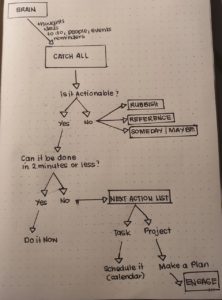
Next Action
Please check out these couple of posts I published related to Getting things done.
if you have any questions just pop it in the comment sections below.
Until Next week.
Much Love,
E


I love this!❤️ Thanks for sharing! Very insightful and inspiring..will definitely apply this although baby steps..looking forward to more of your blogs🙂
Thank you @Teen for your kind words. Yes for baby steps. Conscious and consistent mini steps will definitely get you where you want to go. You are always welcome here.
Wow, this blog is very informative and noteworthy. I have a lot of things in mind that I like to do, but just keep on delaying it. I love that this talks about being productive. Love your work. I can’t wait for more blogs from you.
Thank you so much Marie. Your comment means a lot. We all have a lot to do, so I hear you. Please visit this space whenever you need inspiration. You are always welcome here.