How to get your life back on track (A Simple Reset Plan)
So here we are.
It’s the second week of 2026. I’m really feeling a strong vibe of restarting energy. I’m focusing on a quick reset or a meaningful refresh as I write this post. Not just because it’s early in the new year, but because this is the first time in six months that I feel a bit better. I’ll be honest, it has been rough.
But I’m here now, taking one step at a time and starting again with intention.
If you want a restart or refresh for any reason, stay with me. You’ll learn my 5 simple steps to get life back on track after a setback.
A flat lay of a laptop, notebook, pen, coffee cup, candle, and gold confetti, with a letter board reading 365 NEW CHANGES. Text reads: How to get your life back on track. Simple reset plan. intentionaleblog.com.
This post contains affiliate links which means I receive a commission at no additional cost to you if you click through and make a purchase using those links. See my full Disclaimer here.
Life interruptions happen
And there’s nothing you can do to stop them. It sounds harsh, but it’s the reality.
If you love to plan, you know how good it feels to have one, right? You set your goals, map out your months, and plan your next move. But you can’t plan the moment your body says, “Stop.”
I know this because six months ago, I was diagnosed with a rare medical issue. One gland in my body went rogue and started creating havoc (this is me trying to make it sound less serious). There was no warning or gradual symptoms. It just happened.
At the start of 2025, I thought it would be a great year again. Twenty-twenty-four was one of the best years for me and my family. We started to travel more together. We went to Japan and Philippines plus a couple of interstate travels. We had so much fun. Life felt really good.
As soon as August came, I suddenly became ill. My symptoms pointed to a possible heart problem, but thankfully my heart was healthy. My other major organs checked out fine too. But something in my blood was very wrong. At every appointment, doctors found something else that was off.
A collage of hospital scenes: an arm with surgery scars, a hand with a hospital band and IV, a breakfast tray, dessert and coffee, and two hospital beds. Text reads, “Finding the good through the hard days.”.
It turned out it all tied back to one big problem. And it wasn’t an ordinary one. It was a rare case too. The sad part? Surgery was the only fix.
I went private, and I’m glad I did. From the first medical check to the follow-up tests and scans, everything moved smoothly. I skipped the public waiting list, and I got to pick my own doctors and surgeons too.
So the last six months were all about doctor’s visits, tests, scans, and a few emergency trips. Ahhh, I felt like I dated Dracula every week.
I had surgery in October. It went well but it only fixed part of the problem. Then I had a second surgery in December. It was bigger and more painful than the first.
The rogue gland is finally gone. Yay! Recovery will take time, but what matters now is that the hard part is over. And it’s time to get my life back on track.
Rebuilding your life after a setback
As I say in my Personal Manifesto, life events happen at the right time. Not always when we choose. And it’s true, they happen for us, not to us.
Maybe this happened so I could:
be even more intentional with my life
realise what really matters in this season of life I’m in
align what I say with what I do (I say, “I’m taking breaks,” but honestly I feel I’m not taking enough breaks. When I’m in the flow, I just can’t stop).
How to reset your life
You don’t need a health issue like mine to want a reset. In fact, I strongly suggest to try doing quarterly reset regularly in your normal season. It’s help you live in the now, and more intentional with your goals and projects.
And I get it, sometimes life just gets a bit much, so things pile up and then you start to feel behind. When that happens, don’t try to fix everything at once.
Try the following 5 get your life back on track. This is the reset plan I made for myself before my surgeries. I started using this after my first surgery and it has helped me a lot already. You can use it to do a big reset or just a quick refresh, depending on how long you’ve been off your normal routine.
Flat lay of a workspace with a keyboard, coffee, red notebook, pen, purple leaves, and a letter board reading “Start Now,” with text above: How to get your life back on track: Simple Reset Plan.
1. Stabilise first
Don’t try to fix everything. In fact, don’t start by fixing. Keep yourself stable first, and when you’ve done that, planning the next steps will be easier. Start with the basics and pick just one thing. Choose the one that matters most right now. Then stick to it until you find your footing. Don’t rush.
Here’s what I did.
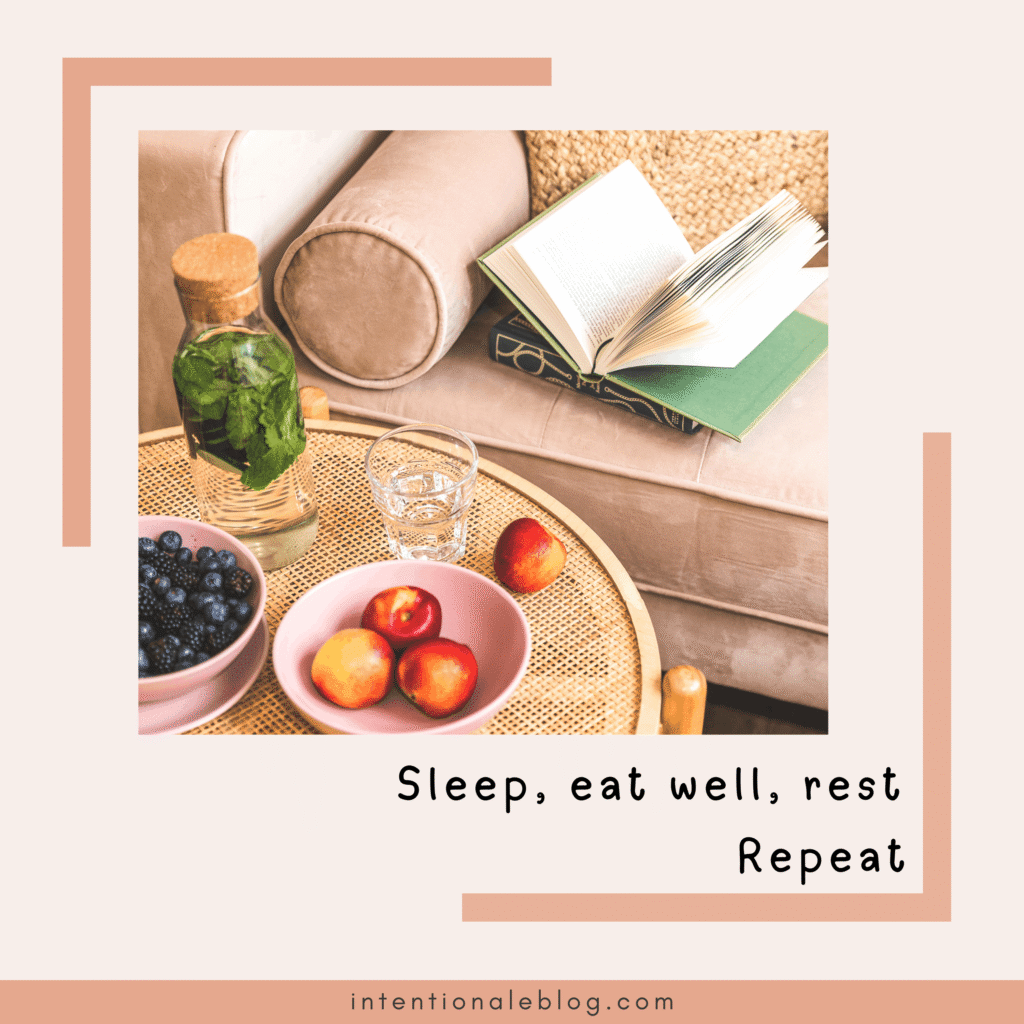
I focused on the basics only: my mindset, food, and sleep. Rest was out of the question because my movement was limited anyway. My meds also made me sleep a lot during the day. So, in the first two weeks after surgery, I did whatever I felt like. I was only strict about taking my meds and managing pain.
A cozy scene with a sofa, an open book, a glass water bottle, a glass of water, and bowls of blueberries and peaches on a round woven table—perfect inspiration for how to get your life on track. Text reads: Sleep, eat well, rest, Repeat.
2. Do a life triage
The word “triage” is a term commonly used in hospitals.
It’s a quick first check to assess patients who:
need care right away,
can wait, and
need a specific type of treatment.
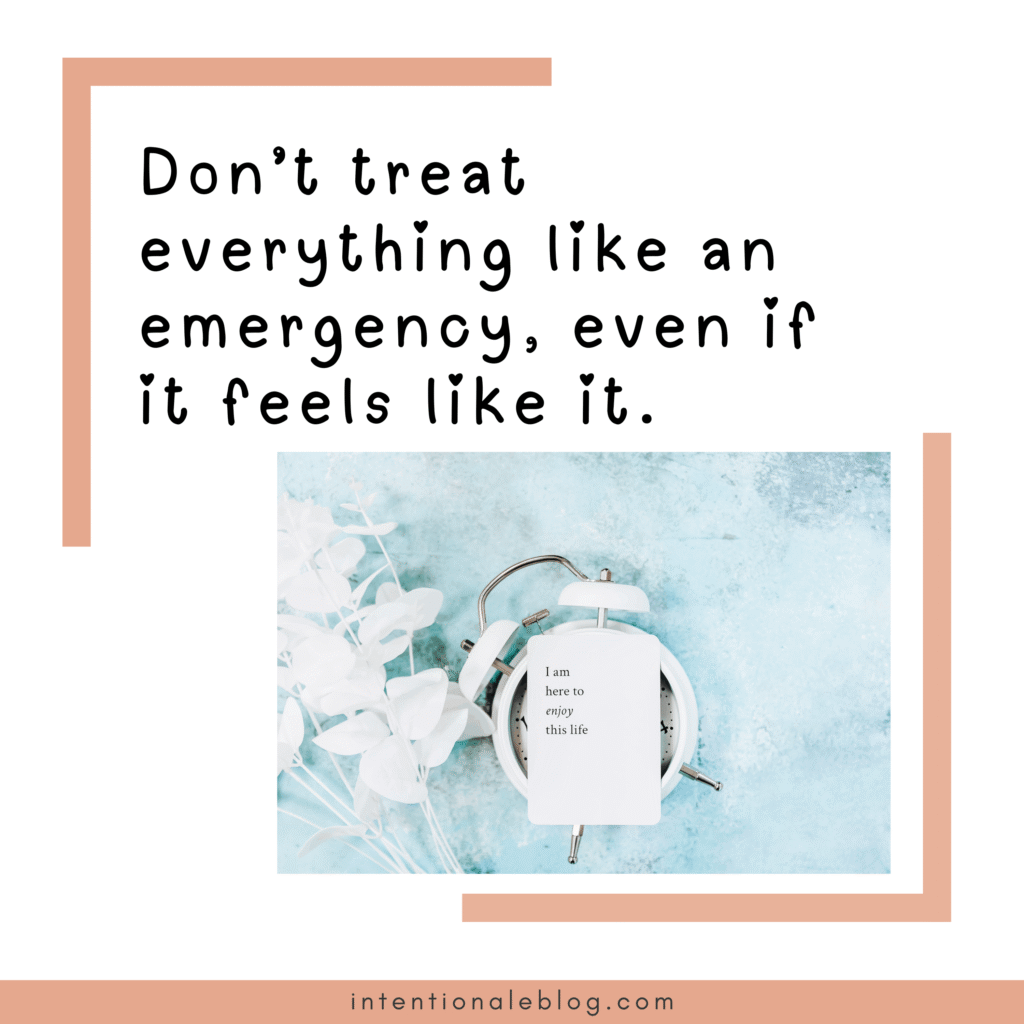
The purpose is to decide who needs help first, because every patient needs a different level of care. And not everyone needs to be treated right away. Doing a life triage uses the same concept. The only difference is you’re dealing with life demands, not patients. Now, it’s entirely up to you how you set your prioritisation method. But one thing I’d ask you to remember when doing a life triage is this:
A quote reads, Don’t treat everything like an emergency, even if it feels like it. Below is a white clock on a blue surface with a note saying, I am here to enjoy this life.
When I started to feel better and felt ready to look at my to-do list, I did a “life triage.” I started with my life domains first. I’ve always grouped them into three anyway, so the prioritisation was easy:
Life
Day job
Side business
At that point, I knew I only needed to focus on my life domain. My day job and side business were put aside until I was ready.
Then I triaged my to-do list:
Must do now: anything time-sensitive, or with real consequences if I ignored it (health admin, bills, family needs).
Can wait: important, but not urgent (most blog tasks, improvements, plans, tidying up).
Not mine or not now: things I could delegate, pause, or simply stop doing.
I focused only on the “must do now” list and didn’t stress about the rest. I’ll get to the “can wait” and “not now” tasks when I’m ready.
3. Keep a clear head
It’s easy to forget to keep a clear head, but it matters more than you think. Giving your mind a break from all kinds of noise helps you think straight again.
The idea is not to feel positive all the time. The aim is to feel steady and calm enough to handle what’s in front of you without panicking or shutting down.
Even after doing a life triage, I still found myself thinking about a lot of things during rest time. Even reading physical books didn’t cut it, and at times, it felt like everything was spinning at once.
So I did a brain dump. This time, I didn’t time myself. I just kept writing until my head felt empty. When I finished, I left it at that and avoided the temptation to process anything. And it felt so good knowing that whatever was swirling in my head was now in a safe place. I could return to it when I was ready.
4. Pick one focus area
Choose only one part of your life to put your energy into first. The purpose is to make small progress. After life interruptions, you might feel like everything is important because you feel behind on everything.
That’s certainly how I felt. But I knew that if I tried to fix it all at once, I would end up not fixing anything.
In my case, I had to pick between health and finance,
Health and wellbeing (recovery) had to be the priority. But finances mattered too. Because while both surgeries were covered by my Private Health Insurance, the out of pocket was still huge. Thankfully my family is mindful with money so, we’re still debt free after everything.
As of writing this, I’m feeling much better so from health, the main focus is slowly inching more into finance.
5. Create a weekly plan
Now that you’ve picked one focus area, it’s time to plan and execute. Do this in that order. Plan first by creating a weekly plan. Then execute by planning your days intentionally.
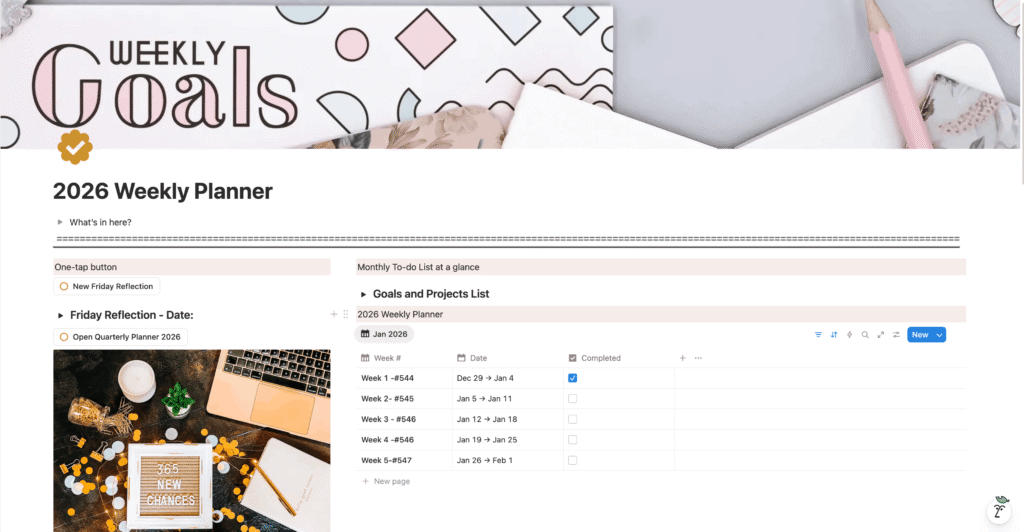
I’ve always kept my weekly plan in a bullet journal. But after the surgery, I couldn’t write well. My right arm was always tired, and it affected my handwriting. It wasn’t as neat as before. So I recreated my bullet journal weekly plan in Notion. Then continued with quarterly reset. I chose my priority focus area and made it my “main thing” for several weeks.
Screenshot of a digital 2026 Weekly Planner in Notion—perfect for anyone wondering how to get your life on track. The page features weekly goals, a calendar table, task checkboxes, and decorative stationery items with a coffee cup beside a laptop.
Home: meals, laundry, basic reset, a calmer space. I’m grateful for my loving husband and my wonderful kids. Each of them stepped up in a big way. They handled all the household chores, even when I was ready to do light tasks.
Money: lower expenses, catch up on admin, reduce subscriptions.
Work/blog: one focus area, one goal, and one system
Relationships: fewer but better connections
Execute with intention
You’re almost set. The last bit is deciding on one habit that will help you keep the momentum. This habit should be small, simple, and easy to do even on low-energy days.
It could be:
drink one glass of water in the morning
write your top 3 must-dos for today
check your calendar before doing anything else
In my case, the one habit that keeps me going is simple: I open my Daily Dashboard in Notion every morning where my Weekly Planner is connected to. This is my digital workspace where I can adjust the things I need to do based on my capacity on a particular day. I can do less or more, but there’s no pressure at all.
Wrapping it all up
I’m sharing this from the middle where I’m still healing and rebuilding things. Not from the “it’s done” standpoint.
This is the reset plan I’m going to fall back to every time I get distracted or when I go off track.
I also know that things will be messy again. I’ll feel tired and stuck again. And that’s ok.
I’ll just follow these steps again, and again.
If this resonates with you, bookmark this page. Or join my email list for weekly tips, ideas, and insights on intentional living. You can do that by clicking the image below to grab a free running to-do list or going to the Freebies for You page.
Twelve months is so long.Yet it seems so short when at the end of the year, you wish you had more time to achieve more. What if we don’t need to plan a year, and plan three months a time instead? My last annual plan was in 2022. Since then I stuck with quarterly planning…
I’ve been a planner for a long time. Setting goals, making lists, and planning ahead always gets me excited. In fact, I’ve been bullet journaling since 2015.And even after discovering Notion in 2019, the core of what I do remains the same.I like thinking ahead. But lately, I’ve realised that getting ahead does not need…
Who would’ve thought that one impulse decision would lead to something beautiful? That writing blog posts would be a good idea, and that it would change someone’s story. Certainly not me, until I started blogging my life. I didn’t realise how much it would change me, my lifestyle and even the people around me. Would you believe…
If you want to bring more structure, purpose and ease into your work and personal life, you’re in the right spot right now. Maybe you’re here because you’re interested in planning. Perhaps you’re already a planner but wondering why your plan isn’t working. No matter what brings you here, I’m sure you’ll walk away with…
There are so many reasons why we fail. And one of them is lack of focus. After reading this post, you’ll walk away with 3 ideas on how to stay focus so you can reach your goals faster. DISCLOSURE: As an Amazon Associate, I earn from qualifying purchases. This post contains affiliate links which means I…
Hey there my Intentional Friends, Gratitude has always been one of my Top Core Values. So, today I am going to share the 3 Simple steps to Practice Gratitude It is time for another Gratitude-themed post . In October 2020, I decided I would make it a Gratitude Week every 8 weeks. So this week,…