
Beginner’s Guide on how to create a Bullet Journal
Hello, my beautiful Friends.
I have a few friends who got inspired with Bullet Journaling recently, so I thought, it would be a good idea to create a Beginner’s Guide on how to Create a Bullet Journal.
Chances are, you might have heard about how to create a Bullet Journal already, or you might have tried creating a Bullet Journal inspired by Social Media.
I wonder about your thoughts about it.
Perhaps, you love the idea of it all but, you don’t know how to start. It could also be, you already started, then you got stuck somewhere so, now you are not sure if the Bullet Journal is for you.
If this is you, stay with me and I will help you decide if the Bullet Journal is for you. If so, I will also help you set one up.
Let’s do it.
DISCLOSURE: Some of the links in this post are affiliate links of which I receive a small commission if you click through and make a purchase at no additional cost to you. See my full Disclaimer here for more information.
What is the Bullet Journal?
Bullet Journal, (also known as BUJO) is an analog system created by Ryder Carroll. For ideas on why I use Bullet Journal you can head over to How to be Intentional using the Bullet Journal method. You may also go straight to the official source.
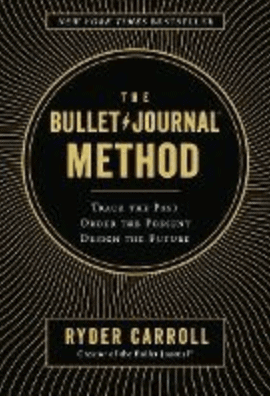
The Bullet Journal method requires just a few things to get you it started. A notebook, a pen and an open mind.
Key Concepts of the Bullet Journal
I was once a Beginner too. For the last 5 years that I have been using the Bullet Journal, I learned 3 Key Concepts in Bullet Journaling.
Bullet Journal can be “Everything”
One of the concepts of the Bullet Journal is to keep everything in one place. You can treat it as a central notebook where you can record everything important to you.
It can be a place for your plans and goals. You have the option to hold all the information about your work, projects, events and everything else that matter to you in just one notebook. It can be whatever you like it to be.
Bullet Journal method is so flexible it will give you freedom and control at the same time. Freedom, because you can always change anything in it, any time. It allows you to control what you keep and what to let go.
A Bullet Journal is a Mindfulness Tool
Some say the Bullet Journal is a Mindfulness tool disguised as a productivity tool. I so agree with this and as a matter of fact, I use Bujo for both mindfulness and productivity.
My top Productivity tool is my Bullet Journal, partnered with The Getting Things Done method by David Allen. I have completed so much personal and professional goals since I started using Bujo in 2015.
I love the idea of Mindfulness. The things is, I have trouble staying still so I can’t do Mindfulness Meditation. Bullet Journaling is has been a great because I get to be mindful without being still, if that makes sense.
Your Bullet Journal can be a Memory Container
Our brain is incredible but we can’t remember everything, especially the minute details that happen on a daily basis. So, having a Bullet Journal to record noteworthy events is handy.
Life is precious. I don’t know until when I will be here. No one does. I get comfort in thinking that when it is my time to go whether it is sooner or later, my Bullet Journal would remind my kids how I tried to be the best mum I could be. It would show them how I appreciate the people around me and how much I value my work whiter it is personal or professional.
Beginner’s Guide on How to Create a Bullet Journal
Like the title, this is just a guide. Feel free to adjust anything according to what will work for you. There is no right and wrong way of doing the Bullet Journal.
Step 1: Start with the Right Mindset
I like to think if the Bullet Journal as my life. I can use it to manage what comes in and what I do with them. Keep what serves me and let go of what doesn’t. That is why the Bullet Journal is a perfect tool in creating an intentional lifestyle.
- Embrace Mistakes
- Your Bullet Journal is your personal choice
- Identify your Style
- Your style may change over time.
Step 2: Collect the Essentials
You don’t need tons of materials to start in setting up your Bullet Journal. Start with what you have.
You will need:
- Notebooks
- Pens and pencils
- Highlighters
- Ruler and pencil
- Post-it Notes
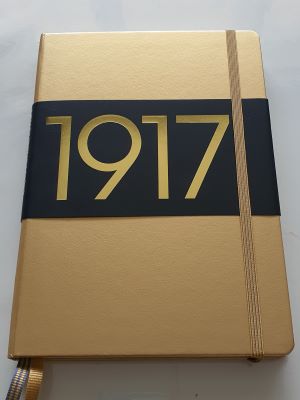
Pick the Notebook you like. I use A5 Leuchtturm1917. I have been using this brand for 4 years now. I used to use Moleskine but I decided to stick with the Leuchtturm1917 because I like the colour choices with covers. Both notebook brands are great.
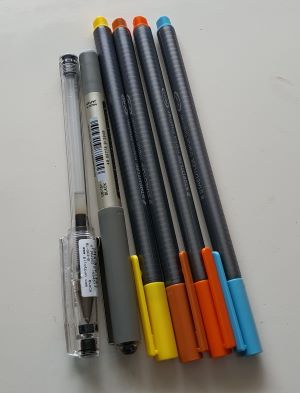
You can use a bullet point, you can use gel pens, and rollerball pens. If you are feeling fancy, you can also use fountain pens. There are so many choices.
My personal favourites are Uni-ball Jetstream, Pilot Hi-tech 2, and Staedtler Fineline Pen Triplus The Lamy Safari Fountain Pen is also a great option if you want a fancy one.
If you like to doodle, having a pencil is a must.
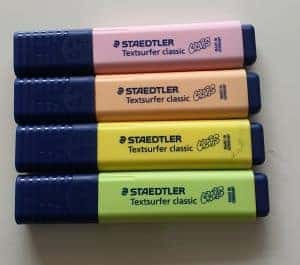
I love, using highlighters. It makes the page alive without much effort. I use Sharpie and Staedtler. Love them especially the pastel colour.
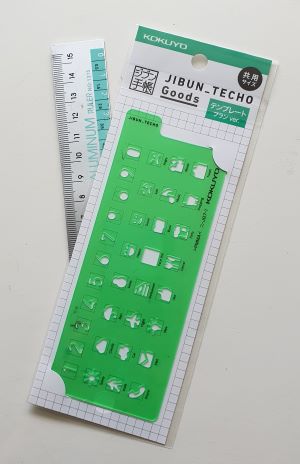
The Ruler is necessary but the Stencil is nice to have. If you can and you have a budget for it, do yourself a favour and grab one. Otherwise, it can wait. I only started using stencil this year and I wish I did it earlier. It saves so much time when you want to create something pretty quickly.
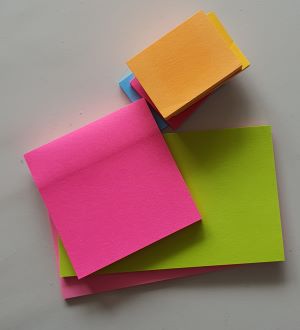
Post-it notes are essentials for me. They are handy for future logs. If you are like me who need to plan as far ahead as 3 to 6 months sometimes, these pretties are going to be your sidekick.
Step 3: Get familiar with Bujo Terms
I appreciate that knowing the terms used in Bujo is extremely important before the creation. So, I have collected the most common terms used.
Key:
A set of symbols used in organising information. The Key is usually created in any of the front pages of the Bullet Journal.
Rapid Log:
The rapid log is capturing your thoughts using symbols to quickly capture, organise, and prioritise your thoughts into notes, events, and tasks.
Signifiers:
Priority, Inspiration, Explore
Collections:
A collection refers to a page that you create to store related content.
The Core Collections are Index, Monthly Log, Future Log and Daily Log. However, Collections are not limited to these four. You can create other Collections like Trackers, Finance, Projects, or Goals, and any related information you want to keep in your Bullet Journal.
INDEX: Used to locate the content in your Bullet Journal. It is like a table of content.
FUTURE LOG: Used to store future tasks and events that fall outside the current month.
MONTHLY LOG: A page that provides an overview of time and tasks for a current month. (Calendar)
DAILY LOG: Daily log: Serves as the “catch-all” to Rapid Log your thoughts.
Spread
Spread refers to a page layout, commonly two-page. Hence, Monthly Log is called Monthly Spread. Daily Log is Daily Spread.
Migration
It is the process of filtering out meaningless entries in the Bullet Journal and then transferring the meaningful ones into the new Bullet Journal
STEP 4: Create Cover Page
A cover page is usually the first page in the Bullet Journal. It can also be just before the Monthly log if you are doing a monthly log as you go.
This is usually for decorative and inspiration purposes.

Before the cover page, I also have this list on a separate page. This is just a little thing I look at to remind myself why I do what I do and what needs to be prioritised. This is when everything gets sticky and I need to consciously drop a ball, I know which one to drop.
STEP 5: Create the Collections
A Collection refers to a Page of related topics. The Core Collections in the Bullet Journal method are Index Log, Future Log, Monthly Log, and Daily Log.
Alright, before you create the Collections, I suggest you do a Brain Dump first. To do this, get. piece of paper and write down everything that you would like to have in your Bullet Journal.
How would you like it to look like> what is the information you want in it? How are you going to use it? Will you be using it as a productivity tool or a general planner? It is all up to you.
Be clear on how you would like you Bujo to be. It doesn’t mean it has to be perfect or fancy. It has to serve you no matter how it looks like.
INDEX
You can create this as you go and it only makes sense because you won’t know how many pages a spread can take.
FUTURE LOG
The Future Log is a spread for taking notes of all the events in the future and all the fun stuff you may have outside the current month. It is a collection of all the important events like birthdays, anniversaries, holidays and anything that you consider as important in a particular month.
VARIATION of a FUTURE LOG:
I don’t have a separate spread for future log because I prefer to put all the future events and tasks in my Monthly Log. I use Post-it notes for entries that are likely to be moved or changed.
MONTHLY LOG
This is simply your calendar. You can create them in one go or one at a time.
If you choose to create them in one go it means you just need to set sometimes to create them in the first pages of your Bullet Journal.
On the other hand, if you want to do them one month at a time, you just need to do the current month first, then proceed however way you like it.
I create mine in one go. So, all the 12 months log are in front of the Bullet Journal.
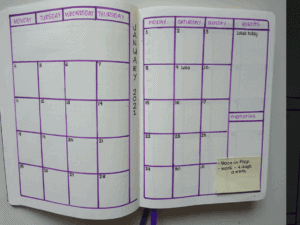
VARIATION of a MONTHLY LOG
Remember, I mentioned above that I don’t use Future Log? It is because I create my next 12 months in one go and I write all the birthdays and anniversaries. If the event or task is likely to change or get moved, I write them on small post-it notes.
Other Bullet Collection ideas
The list below are the other Collections you may want to try in your Bullet Journal. TIP: Please try one at a time. If it works for you then keep going. If not, let it go, and it is ok. You done have to have everything.
- Tracker: You can track habits, water intake, sleep, or finances
- Reminders: Make a list of tasks/events ahead of time and create a page for all of them.
- Lists: My ultimate favourite. This is definitely for all kinds of lists. They can be lists like Gift List, Todo List, Project List.
- Routine: Chances are you have a habit or routine of some sort that you have, so having a page for it in your Bullet Journal is a nice idea.
- Plans: This can be a plan for anything really. It can be a holiday plan, a project plan. The meal plan is a popular one.
- Reference: You can create a page for reference. Information that you need at a certain time like doctors’ information, your health providers, your utility providers. If you have a go-to recipe it can be added as a reference.
- Book Page: Who doesn’t love books? It only makes sense to give them a special place in your Bullet Journal.
STEP 6: Just start.
IF you think the Bullet Journal is for you, then go for it. The best time to create a Bullet Journal is NOW.
Give Bujo method a go no matter what month it is and no matter what season of life you are in.
Enjoy the experience and also learn from your mistakes. Nourish the creativity inside you while you are getting a step closer to your goals.
Final Thoughts
If there is one thing I would like you to remember after reading this post.
Is is my gentle reminder.
There is no right and wrong way of doing it. Give yourself some grace and be extra kind to yourself when you make mistake. You are learning and this might be totally new to you.
When you make mistakes just think that you are still figuring things out. That is it nothing more nothing less. No judgement permitted. You will figure things out. Just keep trying.
At the end of the day, no matter what tools you are using, your success is always up to you.
Much love,
E


